
Sitecore Symposium 2025: Community Insights and Key Takeaways
Konabos Inc. - Konabos
20 Nov 2025
Note: The following is the transcription of the video produced by an automated transcription system.
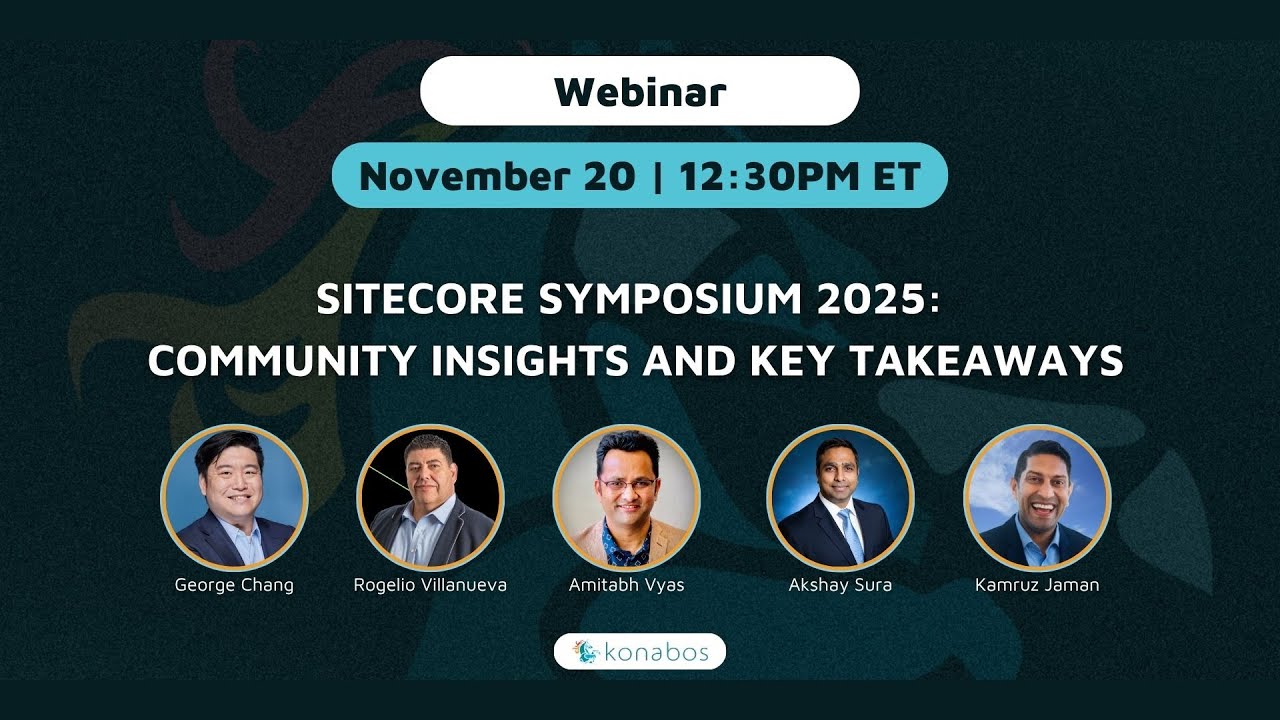
All right, welcome everyone. Today, we'll be doing a panel style for the site, course, symposium, insights and key takeaways, and we have George, Rogelio, Amitabh myself, and Kamruz, so we'll try to do it panel style, ask question, and then people can jump in to give their opinions. So the symposium was held in the infamous dolphin it's been there a couple of times before. It's going to be there next year as well. So at least we don't have to walk between the dolphin and the swan. That's the running joke, if you don't know of it. It's a pretty resort from the outside the conference centers and stuff. So they did a great job. Let me play a 1947 our first transistor was made, developed incredible things. So that was the intro, how it all started, right? The symposium part, and then we went straight into Eric coming on, telling us his story the Broadway show, the Tony the team, the way they raised the capital for it, to make this show a success. And he was trying to draw parallels between that and the business world. So one of the things he had mentioned, the big announcement, was Sitecore AI. And one of the things that he had said is, Sitecore positioned AI as on the inside, not on top. Like, what does that actually mean to any of you guys? Like, does this really matter? It? Does it make a difference if it's on the inside or on the top. What do you guys think I can start us off, if you like? So I think one of the big piece announcement, and I don't think they made as big a deal about all this, was the underlying platform changes that they've been making for the past year, year and a half. So previously, obviously, over the past few years cycles, made a lot of acquisitions right with like the box over acquisition, the order cloud acquisition, and a couple of the other ones. And one of the issues has been they've all been different technology sets. They've been on different platforms, the underlying platform, but now everything is on Azure, so the single platform, which means that everything can be connected. So when they talk about the AI being built from the inside out, it means that all of those pieces are now connected on a single AI platform, rather than, you know, some being in AWS and some being in Azure, and some being on something else, and then, then have trying to connect this, they can now use a singular platform to, you know, to connect all the data that they have that they have access to me this, this is a great initiative, and it is going to be a game, game changer as well, specifically for the customers like us who are not on exam cloud so far. And we are on our way to be transformed. We are on site with XM as of today, and we already had a strategies to go like headless first, and then then, then go to the to the site for XM cloud, because companies like Johnson Controls, which are global, we have very huge web landscape, and it is not going to be us like a big bang project form from going from Sitecore SX to Sitecore XM cloud, with site code AI coming in, there are still couple of open questions need to be answered that three years before we started the journey going composable, and every customer had the opportunity to pick and choose the platforms from the market.
Market now, once, once, once, everything is done is being bundled together, specifically XM, cloud content hub, Sitecore search and so on, so forth. How that product is going to be packaged, right? How, specifically products like Sitecore, Sitecore search, for an example, if, if, if, if a customer is already you using any other platform, part of their ecosystem, how that is going to be transfer, transposed and so on so forth, so customers like us, the migration path, or the transformation path from site core XM to site code, XM cloud is going to be completely changed with the site code AI specifically when, when it is being claimed that AI is not just a top, top layer feature anymore. It is like inbuilt with the platform as well. So we are pretty excited to explore the platform and how that can be packed, how the how the product is going to be packaged in different tiers, and so on so forth. I think it's big to kind of see the underlying philosophy of how they're approaching AI, right? I think we've all used MarTech stacks and products where, you know, they someone puts a magic wand icon next to a text box, right? And then it calls chat GPD somewhere in the background, and then fills it, you know, fills in stuff. And now, all of a sudden, they're an AI enabled platform, right? And which I think is, is a far departure from where site, course, trying to get to right? Like, I think that's the on top versus the inside comment is they're taking their I think the philosophy that Sitecore is taking is, we're building our product around AI, kind of these AI capabilities, instead of just slapping it on top and saying, we're an AI enabled platform. And I think that that makes the to me, that's the differentiator, right? That's what causes this is what's going to make them different, because they're, they're building their products around this platform. And it's, frankly, it's, it's a big gamble, right? Like, AI is so pretty, pretty, I don't want to say immature, but it's pretty, it's still pretty nation around, kind of, in the technology world, and that, you know, they're taking a pretty big gamble on this, and we'll kind of see how that pans out. Yeah, for us. You know, we just went through a major digital transformation, going to ExIm cloud. It's been almost a year now, and you know, we're still fixing and doing some enhancements. So this announcement definitely came as a positive surprise for us, and I'm actually very excited about it. And like, like everybody said here, you know, and everybody the symposium, there's still a lot of unknowns, from the platform being 100% on Azure to, you know, what's going to happen? Like, for example, for migrating from JSs 22.1 to SDK. What is that implies? Right? What about the built in components we had? What about all this other features? But I think, you know, even though there's, there's a lot of questions, I think the there's more positives around it, you know, and definitely the excitement is there so but I think, to your point, George, and I think it's a big leap as well, but I think a big leap in the positive direction also. I don't know if everybody saw that, Eric announced today they're now in the highest quadrant of Gardner. So I think that's very significant to be in that quadrant in dxp, and I think it has to do with all this announcements that came in, you know, out around, around AI, and how it's more focused around the customer, you know, more customer centric. So, yeah. And also, to your point, George, AI is changing so often, so fast. Yeah, every week you hear another announcement. Now we can do this. Now we can do that. And, yeah, it's going to be interesting to see how that pace can be kept up with any of the dxp vendors, really? Yeah, absolutely. And then so the to the next one. So Dave Tilbury came on, Chief Operating Officer at Sitecore. He was kind of mentioning his roots on the agency side as well, talking about trust, talking about, like, no add ons, no upsells. And I think a lot of people had a lot of questions on this one where they mentioned, everyone gets everything. Like, all the customers at least will get everything as of the following Monday, there'll be just one cost. And from like, a procurement perspective, it makes sense, for sure, to have one line item. And then, in a business sense, too, it kind of makes sense because you're kind of giving them everyone a taste of all your products. And if they end up wanting to use a product that they don't have, they could always.
Please ask for it and build upon it over the basic entitlements, right? So the test drive capabilities, basic entitle model, like, how does like from your perspective, from a customer perspective? How does this change the sales cycle or like process? George Roger, you guys can jump in. Yeah, it's funny that we're all customers here. So yeah. I mean, I think as a customer, for sure, it's it makes it a lot more compelling, right? Because for us, you know, we looked at the entire when we looked moving into X and cloud now, site, core, AI, right? When we were going through that process, we took a lot of careful consideration of what are the product suites we're actually going to need immediately versus what would be kind of nice to have that we would integrate in the future in our roadmap, right? You know, definitely things like, you know, a CDP and personalization capabilities and things like that nature were in the roadmap, but we weren't necessarily ready for it day one. And this kind of opens up that ability to do so at an earlier state, having kind of this tier zero entitlement for us to be able to test things out, right? And then, if you know, it becomes really successful, it allows us to expand as needed. So kind of having this tier zero entitlement for some of these products that we don't, we didn't, straight out purchase right away, really kind of opens that door. And I think, you know, for customers right who want to move forward, it's, it's one less step in order to try to get to that next level. Otherwise, you know, we have to go through the whole procurement process again, and potentially a new RFP process and all this just for, you know, for a CDB for instance. Whereas, if there's one already kind of built in and available, right, we can give it a go. If it works, it's great. If it doesn't, then we can go through that whole process as needed, but it kind of just makes it easier for that first step. I agree, George for us as well. You know, we only have ExIm cloud right now, but we were obviously looking at other products. But I think we is it'll make easier number one, to probably get more buy in, you know, and so you can create more POCs, see if it works, how it works, how it can be useful. Create some case studies around that, you know, support your goals and what you're trying to achieve. So I see it. I see it as a big advantage as well. I'm curious to see how, you know, you mentioned procurement, and it's interesting, because how it's going to work, like it's going to be one single contract with the entire suite, or is it going to be, you know, based on your usage per feature, right? So I think those are some of the questions I've been getting as well. So it'll be interesting to see how everything unveils. You know, at least one of the benefit the customers would be getting is basically being the SaaS based platforms, until, unless you are licensed for that, you never get a chance to experience the platform or the tool, or do the POCs, or try it out, right with this, at least, you will get a chance to do some testing and see if site goes everywhere, fits in your business cases, or your business requirements, and so on so forth, specific things like Sitecore, personalized and so on so forth. So I believe that is that is that is going to be really helpful for people to try out. And the buying process is going to be straightforward as well. Rather than buying five different products, going to be just one single shop, even from an agency side, just being able to, as Roger said, you know, being able to have those POCs, being able to run a POC on a customer's instance and show them the value of customization of CDP and the extended, extended customer data of being able to run through, run integrated through cycle connect, because that's also another difficult one to kind of try and sell. It's like, Well, why do I need Connect? I can just build that integration myself, but being able to show the value, how quick it is to use those tools again, it just gives the business more power to actually go back and say, hey, look, they've done a POC. It was this easy. It worked. It didn't work. Maybe you can kind of get on to moving forward or not moving forward with whatever those directions are. So you get to get to use those products quickly and iterate on those, yeah, for sure. And then there were cycle previews. So this was kind of interesting. I like this segment more just because you got a taste of everything, right. So. So Roger got on the on the stage. He kind of walked through like, we can't really thank every single person, but these product owners are here to showcase what their teams have. So they kind of went through a couple of different things. So one of the first ones was the AI pathway. And I wanted to talk about this for a little bit, because it was interesting how they started off, by trying to figure out for moving from XP XM into XM cloud, and how it evolved, how, you know, can save time and money for customers. And they showed a couple of demos, and I know that the one on the stage, but they were also a session or two, I think, on the other days, which kind of walked through being able to pick a source and a destination map the types. For me, what was interesting was the components. So this was a little bit unexpected, because I wasn't really expecting them to be able to map components. I mean, they did mention that it might not move the markup the way you wanted it to or anything, but at least you'll have stubs and placeholders in place in order to move your components, which is kind of interesting. So just wanted you, your guys's take on that, as to what you thought about the AI pathway? Do you see it being useful? I mean, in my mind, if you're already on XM cloud, how would you use it? Is a way I was trying to think of it, right? Probably a great question for myself, right? Like he's there on XP XM. So with a with a potential roadmap to accept cloud in the coming years. So I am, I'm definitely looking for Sitecore AI pathway, because this is exactly what we need in our ecosystem.
As I mentioned that we are global company, and our web landscape is very vast. From last six years, we were heads down building a solid component repository which can be commonly shared between 400 websites. And every year, with the mergence and acquisitions, more and more websites are coming to our ecosystem. And it is. It's been very difficult to put a like an enterprise level architectural governance in place. So now we are at a stage of any website you give us 80% of the task is just a content migration. We already have those capabilities built on the platform where there's no new development or new announcement required, but the content page itself is the bigger piece to buy it right and platforms like this, who can understand our ecosystem first, what all capabilities which we have on the platform so that we can pass on our website, it can do the comparison, produce a report, and help us to migrate the content, whether that can be migrated to XM cloud. That is the place where it will be making our XM cloud path more straightforward or easy, because now we have the source and target platforms defined. So we at Johnson Controls are definitely looking to try site for the iPad. Going forward, we'll see how helpful that was. That really for us. Yeah, you know, we're in work, work, maybe like half a step ahead, right? Which is we are in the middle of a content migration right now between our legacy XP side and to a new XM cloud site. And so we've had a lot of conversations with site core about pathway in the past few months. Just you know how to use AI to help enable that, right? Like ham mentioned, like migration is such a huge piece. It takes so much work. And so, you know, whatever kind of efficiency gains you can get from the migration process is going to play a much larger part than anything else. So anyways, like having being able to map components from your old site to your new site, even if they don't entirely match up, and kind of using AI to do so, I think is a really big deal. The otherwise, how we used to do it, right, is it must be a much more manual process and took a lot more time. I mean, migration toolkit has been available for a while, right? But that was just a straight up one to one. Mapping from XM XP to XM cloud. You know your content exactly as it is, your templates exactly as it is. I think there's obviously the two big differences. Three probably big differences. Is the biggest one being that you know the mapping of the components at the very least. That's going to help, even if it's just stubbing out very fast phase. The AI pieces are being able to transform data from A to B, as you're doing the migration.
And the third piece is, of course, being able to migrate from non cycle websites as well, right? That was the other. Other announcements there. So I know what I think one of the couple they've mentioned was WordPress and my friends over and Optimizely. I know they like to, like to shout a lot and make a lot of fun, but fun to do it the other way around now, right? And migrating across from especially those legacy optimizing the epi server websites. I think there's a lot of work to come on this AI pathways, and I think it would be really, really interesting if they made it open source. Be really, really cool, right, to see how we how the we can then extend it for again, particularly as an agency, or even for Amitabh, taking those 400 websites across, being able to go in and really customize that migration pathway for their particular use cases, because they probably have, you know, out of the 400 websites, we probably got a lot of variations that they need to cater for, although this is that it's very important to note that when a when a website need to be migrated, it is not just migrating to site code. It is being migrated to your martech architecture. So there are lots of bits and pieces involved, your PIM integrations, or your location management software, your compliance. So it's a very complex process, even with just migrating the content, whether it is an as is migration, or if the website is like, 30 years old and that need to be migrated, the content is not relevant anymore to the current, current audiences, so the content need to go through the new content creation process and so on so forth. So I believe this is going to be a game changer for the customers who are looking for digital transformation for the legacy websites to the new dxps.
Yep, makes sense. And then following that, we got another preview on analytics. And this one was interesting because it was component level analytics in terms of like scrolling, clicking, which was very interesting. He mentioned, like component level analytics, which feeds into AI agents, which sounded pretty cool. So is this like, I know, in the previous like XM based personalization, you could customize quite a bit with X connect, even though it was kind of a little bit scary at points. But do you think we are done with everything that we needed for personalization on this one? What do you guys think it's never going to be done? Right? But it was interesting. I feel like some of those pieces were going back to what we had on XM XP, like click, level tracking, goal tracking, or the equivalent of goal tracking and things like that. So it will be interesting. It kind of felt, I mean, you guys have been around for a while, so you remember when they first announced horizon the editor, the kind of sibling which was zenith, and Zenith was supposed to do all of these things they're talking about now in with this analytics. I mean, it's great. They'll go wrong if they, if they pull this off, it'd be like, page level, you know, component level tracking. If they can pull in things like heat maps and, you know, things that, that kind of tracking as well. It's going to really, really empower the marketers, combined with things like AB testing as well, right? And AI based analytics and customization it, yeah, it's going to be a really powerful combination. And let's see how, let's see how they how you can do extension points. I'm sure we'll get to marketplace. But if they can almost do our marketplace like extension points for your personal, your own customization, for this kind of personalization and tracking, then yeah, it just becomes even more crazy. This is, this is a picture that definitely we're very, extremely interested in and seeing, right, especially at the component level, because right now, we rely on tools like, obviously, Google Analytics and heat mapping tools, and, you know, you use a combination of tools from your marketing stack, right? So seeing this, honestly, was very exciting, especially for us when we want to target specific audience or personas, or do you know, we invest a lot in in in advertisement, you know? So you want to make sure that you're actually spending it well, especially in this times, right? So, yeah, it's definitely something. We're going to be testing it out and see. And obviously, you know, our analytics department, obviously, one of the things we always do is compare with Google Analytics and see what's the main difference. You know, like, for example, if you compare other tools, like similar web or SEMrush or any others, you know, there's always that discrepancy.
Sometimes, like 20% or something like that in traffic difference. So it'll be very interesting, because this is, if this is coming from the core of Sitecore usage, you know, it may give us better information, you know, of the usage for and it may give us more information on personalization and more targeted audience. So definitely a feature that I'm really looking forward to, especially in our industry. Yeah, I totally agree. I think the accuracy bit is big, right? With third party you can only get as much as you can, and then you're have to deal with things like cookie consent and things of that nature, right? So, you know, if we can get this kind of first party data from the core platform itself, and then this kind of working hand in hand with the whole, maybe jumping ahead a little bit with the whole unified data platform that they want to bring in right to be able to take all this, all this data and analytics and be able to have it and then provide extension points for reporting through, you know, Power BI or some data connecting to a data lake, or whatever it is, right now, you've, kind of, you're able to get a more representative set of your data, representative data set of data for your users, right, that you can pull into other platforms to be able to do additional analysis and such. So, I think it's not just it's, it's, you know, it's not just silo to the cycle platform itself, but being able to take that and all the other data that it kind of lunges together, and then being able to use that in other places and extract it, I think, is really big. Have you guys? Was there a session on gradial or, like I did, see quite a few people with Gradle shirts on, but I don't remember a session being there. Do you guys know if there was a session on gradial, or any mention of Gradle at all? There was a breakout session, right? Yeah, there was a breakout session. Anish was there, I think who's the chief growth Officer of radial. And they talked about like from very high level, how that partnership will look like going forward and so on. So there was a record session. I was there, awesome, all right? And then next, there were a couple more. So this one was kind of interesting. So Liz was talking about releases and having, and this seemed like an over encompassing thing. I didn't really grasp it 100% but kind of got the idea right. You have different types of content and all other things that you have queued up, whether they're email or different channels or website, and then you want all of that to launch at a specific time when, when you want to launch the content across the globe, or whichever part you wanted to so, so publishing to the second with campaign grouping and one click rollback. I honestly don't know how the rollback will work, especially in medium channels like email right or social media, when you push a post in, how do you take it back? But sounded like a really cool concept of having a release concept, set everything up, tag it to the release, and at least from a Sitecore perspective, push everything. I don't think there was code related to that. It was mainly from a content perspective, I believe. But like, do you guys envision? I'm sure you do this for your product launches and site launches and stuff. I'm assuming this will make it easier. Does did it sound enticing for you guys?
Oh, yeah. Like, this is, I think this is a big thing. I know there are some other kind of SAS content, CMSs that have similar kinds of features, but you know, it is for those of us who have kind of came up through the Old XP XM world, right? And kind of figuring out where all the various places are that need for things to be published. And then in not just setting the publishing restrictions, but going back in and publishing it all and making sure it's all out there. You know, you have promo cards and things across all across your site making sure those are live. You know, just when you're launching a campaign that touches so many different things, to be able to synchronize on and make sure that have that basically, have that confidence of making sure that things are going out at the right time, what when it should be going out is, is, is really key. I think the stuff that's powering this under the covers, as far as the rethink of how content is being stored in site core, is, is. I mean, it's, to me, it's kind of game changing, right? I think I don't know how much it got discussed. It didn't get discussed a whole bunch of in previews, but I know there was a session during symposium where I talked about, where Liz talked about, basically just the revamp of the underlying content structure and the. Data infrastructure underneath for content, which, you know, previously was a bunch of SQL Server tables, not very AI enabled, and, yeah, having having a more modernized tech stack for content, and being able allows us to be able to do things like, you know, flip a switch and have a campaign launch across our website all at the same time, right? Yeah, I think it's, it's kind of the next big iteration of content in Sitecore.
So I know we discussed it a little bit, right? GEORGE around the new content service is what you're talking about. And that session particularly is actually, it was actually really interesting and quite exciting at the same time. And I think it is exactly as you said, George, tied to this releases, because they're moving from SQL server in the background, which has been a huge pain for publishing for all related tasks, to Cosmos dB, which will allow them massive scaling, and to be truly, truly a SaaS tenant based SaaS products as well. But what's been, what I think, and thinking back at it, what was really interesting is, because of the fact they've gone to this SaaS model now cycle, can actually make this change in the background, and you are the customer. Don't have to worry about it, because it's then cycles problem to move you from these current SQL Server XM based back end to this new Cosmos DB and whatever else middleware that they're going to have to rewrite in between to get you there. So you know, that's just the power of SaaS, and that's the power of being on this new platform that cycles, continuing to iterate, and making these things so much more robust, so much faster, so much more modernized, without you having to worry about it. From a customer perspective, a marketing customer perspective, the internal customer, the, you know, the marker, the content author, the web designer, the content administrator, to me, was golden. When Liz Nelson said, you know, live publishing, and when she said, like, publish is no longer an act of faith, she said, It's an act of precision, that, to me was like capital letters, you know, golden underline. Put it out there, you know, because that site core to me, you know, it's, it's all about improving, not just the external customer experience, right, what everybody sees, but the internal customer experience, right? All of you have people that work on a daily basis with Sitecore, and we want to improve that customer experience. And what's the number one thing that everybody wants to have? You know, make sure publish it. Publish works 100% right with efficiency. So the fact that they looks like they revamped somehow this, they didn't say a lot of details. It's very exciting, and it goes along the way with this release or orchestration, right as well, like, kind of like bringing it all together, the campaigns with partition, the different touch points you touch on the rollback, which is kind of interesting to see how that is going to work, right, because you're right, like, if you send something on social media, that's it right on email. So, but so would be interesting to see how that actually goes in, or I'm thinking more from a content perspective, maybe, or maybe, I don't know, from an email perspective, maybe if you sent a million emails, maybe the first 5000 you can roll back the other 5000 I don't know, you know, but the 500,000 I don't know. But definitely, I think orchestration was mentioned a lot, which is kind of like bringing everything together, right with this publishing power on as a foundation. So yeah, I think that's definitely something to look after. If you take aside the social and the email piece and just think about the content piece on the website. How, if you were to go live on campaign, and assuming you've picked every single little element and you schedule them all correctly. It's a pain right now, right? Because you're not you have to individually schedule things, and you have to individual, individually, almost publish things. Because if you do an entire site, publisher could take ages right through the big content store. But then think about how, how, how is it even possible to roll back at the moment? Right? Because you have to individually go and roll back stuff at the moment, which is, yeah, it's just, it's just mind blowing. But the content service presentation was really, really interesting. And a lot of these concepts and being able to actually, they had the concept of a Git style forking of content. So you're. Taking almost a snapshot of content. So you can then split those out between two of your marketing teams, or two different people in the marketing team. They can individually work on two different streams later, on Kamruz. And I need you to speak then, because he knows more about the than I do. The next one was mo kind of came on, and he was talking about the agentic workflows, how you get a certain amount with Sitecore, and then you can also customize these. And they were kind of constantly, kind of talking about this, like making things your own, like you can customize agents. You can add your custom apps like extend it using the customization options that you have. So they mentioned that they're launching with like, 20 pre built agents, which is really good. A lot of them are, like, auditing related. The best way I could put it like which can help like a marketer. But is this something that you guys can see investing in to build your own custom agents to do things which fit your orgs?
The are you talking about the out of the box, or like the built in ones, or like the ones you build building custom so basically, they mentioned that you can create custom agents to fit your needs in your own instance, of course, but yeah, do you see like based on what the brief things that you can see, like the geo SEO, the analytics, think George, I think you posted something recently as well on this. Do you already have ideas in mind, like, oh, we can do these 15 agents. Yes, definitely for us. Yes. When I was looking at this, my mind started going into so many different directions. Honestly, obviously, it's, you know, it's especially because of the tool. You know, when you look at when, when a genetic started, you know, what you look at all this tool that it's, it's, it's all code based, right, and a whether you were used as Python or whatever. But looking at this other tools that have emerged, which is kind of like drop, drag and drop, and adding your tools and creating this seamless agents. Looks like Sitecore took that approach where you can drag and drop, and so it's very exciting to see, because, you know, sometimes you get requests for something that instead of going to the entire development cycle, you may just create an agent that maybe you're going to need it, maybe temporarily, right? And you don't have to go through an entire, I don't know, pi planning, or sprint, or whatever it is. And if you have the capability of creating this agent easily, then it can serve the purpose, right?
Also, I see this as improving workflows, improving as well efficiency in some cases, you know. And like it said in the symposium, is not AI overtaking the work, but it's actually working together where you direct AI on the things you want to accomplish. So definitely for me, our teams and our industry, I do see this as a big advantage, and yeah, can wait to take my hands on and start creating. And the best part is like, whenever you fully build, building an agent, if you think that it is going to be a generic problem which the other might be facing, you can make that agent public, or you can build it very specific to your organization, which could be just an internal use. So, yeah, I was excited about the example they gave. I don't know how realistic this is, but having agents work for you while you're not working, right? So overnight to see if there's a dip in traffic, and if there's a dip in traffic, to be able to come back and say, you know, maybe these are the content changes that you can make that sounded interesting to me, yeah, the one thing though, that I guess every organization should consider here, probably they're already thinking about it, is the legal aspect in the governance, right? Because, for example, many companies, they don't allow you to use all this agents, right? So what's going to be the process of allowing them, like, for example, if you create an agentic agent that is going to use some sort of tool, some sort of, I don't know, API, or something, you know, you're still going to have to go through that legal process, maybe in working with IT department, right? So it's, it's not like you're going to jump in probably and do all of this, right? So there's going to be some process. And it's, and it's good, because it requires, you know, you have to make sure that you have the proper security in place as well, and you're covered by legal and all the different aspects. So I, I would encourage people, if they're watching, that you.
Don't go you know, it's okay to go crazy on it, but make sure that you have your cover by legal, by it. You know the proper processes that you're doing the right thing for your company, right? So be sure you do that before. Make sure you have the governance in place first. So know, I'm unmuted. Thank you. I was just looking through my thing, and then there was a lot of talk, and I wanted to pick your guys' brain, because I don't know if it was something I didn't understand, but the way I understood it is they kept on talking about custom size, right? So they were talking about, you can still use Sitecore connect. You can use all of these agents and customize the agent. You can use the marketplace, and you can customize the app, so whichever works for you to customize your Sitecore. AI instance, these are the four or five, and then the design studio was the other one, which was pretty interesting, was that the simplified custom SaaS platform that they were talking about, or did I miss something in interpreting it? I have, I mean, there are still lots of question to be answered, but I have, I have mixed opinions on this. When it comes to customized SaaS, I believe the key factor is going to be controlled customizations. Whenever you are, you are picking up a specific platform on which your site could need to be hosted on something, your other platform need to be hosted on something, and so on, so forth. So customized. SaaS as definitely is going to empower the customers and the and the partners, but at the same time, isn't it shifting the ownership back to the customers whenever it comes to the platform, scalability or enhancements, and then all those type of stuff. So that is something I'm still not sure on. Yeah, I mean, I think it's less about enhancements and more about, like, very customized kind of use specific type of customizations, right? Like there's something that you in your organization has a very specific need, maybe it's an integration to an internal, homegrown platform, or something like that, that if you know any other SaaS software like you wouldn't have a very good entry point into and to be able to service some of that information up into the platform that you're already working out of, or to take action from the platform that you're working out of to something that is very specific to organization. I think that's where this is. This is really powerful, right? You know, usually the SaaS mindset is, you buy a piece of SaaS software, and then it's like, okay, well, we'll give you some APIs to kind of connect into it if you want to do something external to it, but not a whole lot of opportunity to to surface what you want to surface or provide functionality for things within the platform itself that you're working out of usually, typically it's external. You call API's into this platform, but then you know you have to manage it externally. And I think this is where this differentiator really is, is being able to integrate those, the customizations right that you typically would have external to your platform, directly into the user interface of the platform itself.
Yep, exactly. Nicely fills in the gap from what we had with XM XP, where you can go in and customize literally everything, to what is essentially the stop gap, right with XM cloud, where, like, yeah, you could go in and, you know, override some stuff on the base images. We don't recommend it, because it's going to, you know, it's going to cause you issues. And we already know about the upgrade cycles, right? And this is one of the reasons that people are moving to SaaS, is because of those constant upgrade cycles and the difficulty with those upgrade cycles. So again, the custom SaaS piece fits in now, fits in nicely where people go in and make those light customizations without having to make changes on the underlying guts of the product and causing themselves headaches with upgrades and future enhancements. Yeah, I think it opens up the path for a lot of customers, for XP, to say, core AI migration now as well, to be able to, like, I had a lot of customizations in my whole XP platform, right? How can I possibly move? And this helps that quite a bit. Now, finally. Kamruz, his favorite topic. This was something which, which was of interest. So when Kamruz mentioned this session, it was kind of interesting, how they were going about it, right? So they were talking about, and Kamruz jump in whenever you want. They were talking about content as a service, being able to use Cosmos DB for cost purposes, performance purposes, but not just that, just re architecting it in a way that publishers are, like a flick of a button, literally not having to wait even few seconds for it, or being able to move from one thing to another. How easy it is, like the way the items are stored right now, as opposed to how they would be in content as a service, the quickness of the search. More thing on vector based searches, because now anything AI related vector searches are in right there trending. So it was interesting to hear about it. I didn't go to it, but Kamruz did, and then this is what he was talking about, which is git based content, where you can move things over, do what we do with code currently.
Talked about the semantic search as well. And then why they chose Azure Cosmos dB, and they're actually doing a talk at Microsoft build on this exact topic. So that's kind of interesting. And then they also talked about the speed, the cost, and they went through quite a bit of it. So like moving from SQL to Cosmos, I think will be like the they're probably going to do, like a hybrid to approach, to get into it. But for someone like you, right, like this will hit you directly. Like, what do you see? How the implications would be like if there's an upgrade to Cosmos DB for your instance? I didn't attended this. This, the session was but this reminds me when site code eight was launched and there was a sequel to MongoDB. Transition was a fun time. So yet to explore what, what this whole thing would be, would be bringing in we are Azure shop, or we are, we are Microsoft shop in JCI. And if this is something happening, need to do a bit of apple to apple comparisons. The benefits, which, which this, this, this would be coming in. Publishing is always a pain. Specifically, if you are on site code XP or XM, and if you are doing a large scale publishing schedule, publishing is a myth inside core XM and XP, especially when, when things are in the place, like your own custom CDN or your own WAF and so on. So there are so many things to troubleshoot if things are not working out, but based on the numbers, this looks something promising, and which we would love to explore going forward, for sure.
Kamruz you were about, you were explaining the kids tell Can you tell us a little bit about that? Because that's yeah, okay, we'll go back a couple of slides, and I'll talk about the concept that Liz had mentioned, and George as well. You can jump in, because I know you're obviously a current and Uzo Roger, you guys are obviously current accent Cloud customers. So I think on the publishing side is going to be pretty interesting. But this, this was very interesting concepts, where, essentially they'll say you could almost branch out the content, not the code that the content, so you could work on a campaign by yourself, while you know, the production site just continues to roll on as it should do, and you're just off on the side. I'm just gonna, you know, get this campaign prepared. Campaign launched, and when I'm ready, I'll just bring it all back together right into the main branch. So, but to think about this from a development standpoint, let's say, right? So, I mean, I no longer, because I'm using because I've got a team of front end developers. They're working on, working on the build. They don't run anything locally, because they just have, you know, the next JS components, running projects running locally, and you're working against a a remote instance or cycle right assess the cloud instance or cycle. And we've seen this before. We see this. We saw this way back in the day when we used to use shared databases. We see this with a lot of other SAS based CMS products, where two people are working on two different things. One person goes and makes a change, the other person doesn't have the code for that. The other person's code is now broken because, you know, they're out of sync. Effectively, until the code is all pushed up, the code is all synced, this will prevent that I can now split out a branch, or, actually, I can split out a branch myself. I can break a branch. For George, we can all work on separate pieces of functionality, and then once we're happy, along with our code, the things just get merged back in. So I think from a even a lower down, not non production, not non campaign launch, there's a lot of advantages, yeah. I mean, I think it opens up a lot of doors for some really interesting things, right? It's a, I mean, you're effectively looking at this is you have as many master databases as you want, and you have as many web databases as you want, really, when you get to it, you know. And, you know, Kamruz, example of development is a really good one. I'm sure we've all hit that scenario at one point or another. But even from, like a marketer side, right, the ability to branch something out to, you know, have a, have a proper preview environment set up for stakeholders to review, right, or, you know, or even setting up multiple preview environments for different stakeholders to review for different things, right, like you're not so bound to the, like, the dependencies on content, right? Like, oh, I can't make this change yet, because someone's still looking at it. So I can't, you know, make this update like that. All kind of goes away. You have a lot of flexibility and how and when you manage your content, how and when you publish your content, right? It kind of gets us to a little bit closer to this. You know how, like some platforms have multiplayer, like Figma, where, you know, you see cursors flying all around and whatnot. It gets us a little bit closer to that, but a little bit more responsibly done with branches, I think. But, yeah. I mean, I think even from a to from a scaling perspective, for a large enterprise, who has, you know, tons of marketers that could all be working on the same page at the same time, this enables a much better experience for to be able to work in parallel as well.
Yeah, it gives them freedom to experiment. Coming back all down to it. George, what's the most underrated announcement that didn't Yeah, feel like I mentioned it earlier, but definitely, I think the content service was the most underrated, unannounced, like, not main stage announced thing. Liz talked about a little bit in previews. But, you know, for some of us who have kind of worked in the psych war space for a long time, like this is a long time coming to move away our, you know, good old master and web databases. But I think it's, it's not just the infrastructure change, but all the potential doors that opens up for all the cool things that can happen, like the branching content, right? Like there's way more to come, right? The speed is huge, right? As far as you know, not waiting for publishers, I think it really helps bring site core, as a from a content management perspective, into the future, right? It's kind of a becoming. It's the underpinnings for making it a modern CMS, and all the things that a modern CMS like that we would expect to do. So I think, you know, while it's not the most, it's not the sexiest or has like the most bells and whistles and the flare, right? I think it's what's going to drive all the cool stuff in the future. And I definitely think the content services underpins releases, right? That instant releases begin to roll back and things because it's moved from being you get it gets rid of a master call web database, right? You just have the database that has everything. And now you've gone from, you know, having to do publishes, to just having a this, you know, a date, time step, essentially on each piece of content, saying this is when this becomes live. And that's what allows the instant publishing and the instant rollbacks, but yeah, for me it would be, yeah, content service, but the releases being the top of that piece, rohili, what about you? I'm not sure it's a good question. No, you know, it's to me, everything was relevant. Honestly, it's, you know, I mean, I've been using site core for 12 years, since, probably, I don't know, version six or seven. I can't even remember, you know, all the way, all the way to 10, and then we just migrated. No, actually, we didn't migrate. We moved from legacy systems to XM cloud. I don't know. It's hard to say honestly. I'm not sure. Honestly, I think, I think I would agree with George, probably on that side, because I agree there were certain topics that were not mentioned upfront, but they were like side conversations, you know, especially like.
With nails and brew. Just like, oh, okay, okay, that's that sounds very interesting. So tell me more. You know, yeah, I think one of the conversations I had with this was around publishing, and I know they talked a little bit about it, but I went a little bit more in details. And I think because that's like I mentioned, you know, that's primary for me. It's a top notch. I mean, that's top priority for me. So, yeah, yeah. I think more details on that. It's probably a little bit on the radio, but it's Yeah. Amitabh, what about you? I can't think of any better example this content. I mean, people who have not attended that session, which you are referring to campus. Have no idea that this is something coming up, and it's exploring, and it's going to be game, game challenge in the in the terms of content publishing, for sure. Yeah, from what they're saying, it's, it's not even that far away. We're talking like around February, March is what they're aiming for at this moment, first out next year, yeah, talking about retiring the current set of base images, like the XM XP based images, in the next year they leave, leave it hanging around, just because they need to for some time. But, yeah, we're not, we're not talking a long period of time symposium next year. You know, this will be the thing, XM XP publishing in XM cloud at least, or cycle AI is gone. But the other, the other thing I will very briefly mention, oh, sorry, Roger. Do you want to No, no, there was some interference.
The other thing is, there was a session on XM XP specifically, and that it's moved to.net Core, and how they're going to go about doing that, and that should be starting middle next year as well. So again, keep a watchful eye on that one, because there are still a lot of customers who do want to, or need to, for whatever reasons, host themselves and keep data, keep their data sovereignty. So it's going to be interesting to see the journey for on prem to move to.net Core, whilst at the same time now essentially XM cloud cycle AI is diverging so hugely. And bear in mind that they can't run this new.net core version on Cosmos dB, because Cosmos DB is in Azure only. You can't run that on prem. So it's going to be interesting to see how these platforms change, and how they diverge, and what that migration path will look like going forward, hopefully, pathways AI will take care of it for us. The one thing I do want to tackle, though, we still have a couple of minutes, really, you mentioned this. It's about Azure, moving the products into Azure. And the way I understood that part is, you know how like they were, lot acquisition, search and then style labs, for the content hub and all of that. The way I understood it when they mentioned everything was moved into Azure is that all those different product lines were on different infrastructures. As far as I understand, they were able to move them all onto just Azure, so that everything lives on Azure. I think there was a little bit of confusion from like a audience, first feeling like, what does that have to do with me? Why are you telling me everything's moved into Azure? Because are you telling me that I need to move into Azure because I use AWS. So I feel like there was a little bit of confusion, but that's the way I understood it. I don't know if you guys thought of it differently, but I did want to mention that, yeah, when, you know, I started getting questions when they announced that via text, like, what about vercel? You know, they asked me, like, do we still need vercel or not, right? Because, do we need Netlify or any of those ones, right? What does that mean? So, what's a very clear still? So I guess it's still the TVD.
Yeah. I mean, I think my understanding of it was that everything was being moved to a common cloud platform, and that enabled them to do things like that, unified data analytics, data lake, data analytics, kind of stuff, right? Because now they have all these platform like all their products are kind of feeding all their analytics into a common place, whereas they wouldn't be able to do it before. Yeah, I think some of the messaging probably could have been a little bit clearer about all this, right? Because, frankly, I think it's something that, you know, the move to Azure is great, and, you know, they, I'm sure it was a big feat on their side that they're very proud of. But I think from a user perspective, you know, we'll, we'll see the fruit. Of that labor, but kind of more indirectly. And, yeah, and I think there definitely was some confusion. I think to help clear some of the confusion, Raj, do what you were talking about. I think the vercels and Netlify is are still going to be around. You still need a French State platform for XM cloud now, site, core, AI, right? So, and you know, people have tried to host it on Azure, frankly, not the best experience. If anyone has tried, they could probably testify to that. But I think a front end hosting something needs to host your front end application regardless, and that could be anywhere. You're not bound to Azure. You can host it in AWS, honestly, if you really wanted to but yeah, I think the key thing was that they've moved Sitecore has moved all their products under kind of one singular cloud, and it helps enable some efficiencies and some additional functionality because of that cool I know you guys, this time is valuable. Thank you so much, guys. So George, Rogelio, Kamruz, Amitabh, thank you for your time and your insight, and this will be pushed directly to LinkedIn and YouTube. So have a good rest of your day, guys. Thank you so much. Thank you everybody. Thank you for having us. Yeah, you.

Konabos Inc.
Yay to Konabosing in style! Content tagged with the Konabos handle is produced by two or more Konabos team members.