Your brand blog is the weakest signal
Akshay Sura - Partner
21 Nov 2026
The uncomfortable part
Kaleigh Moore gave a breakout at Sitecore Symposium called "Source signals: how AI answer engines decide who to cite." The framework behind it has one idea most marketing teams won't like. The content they control is the content AI trusts least.
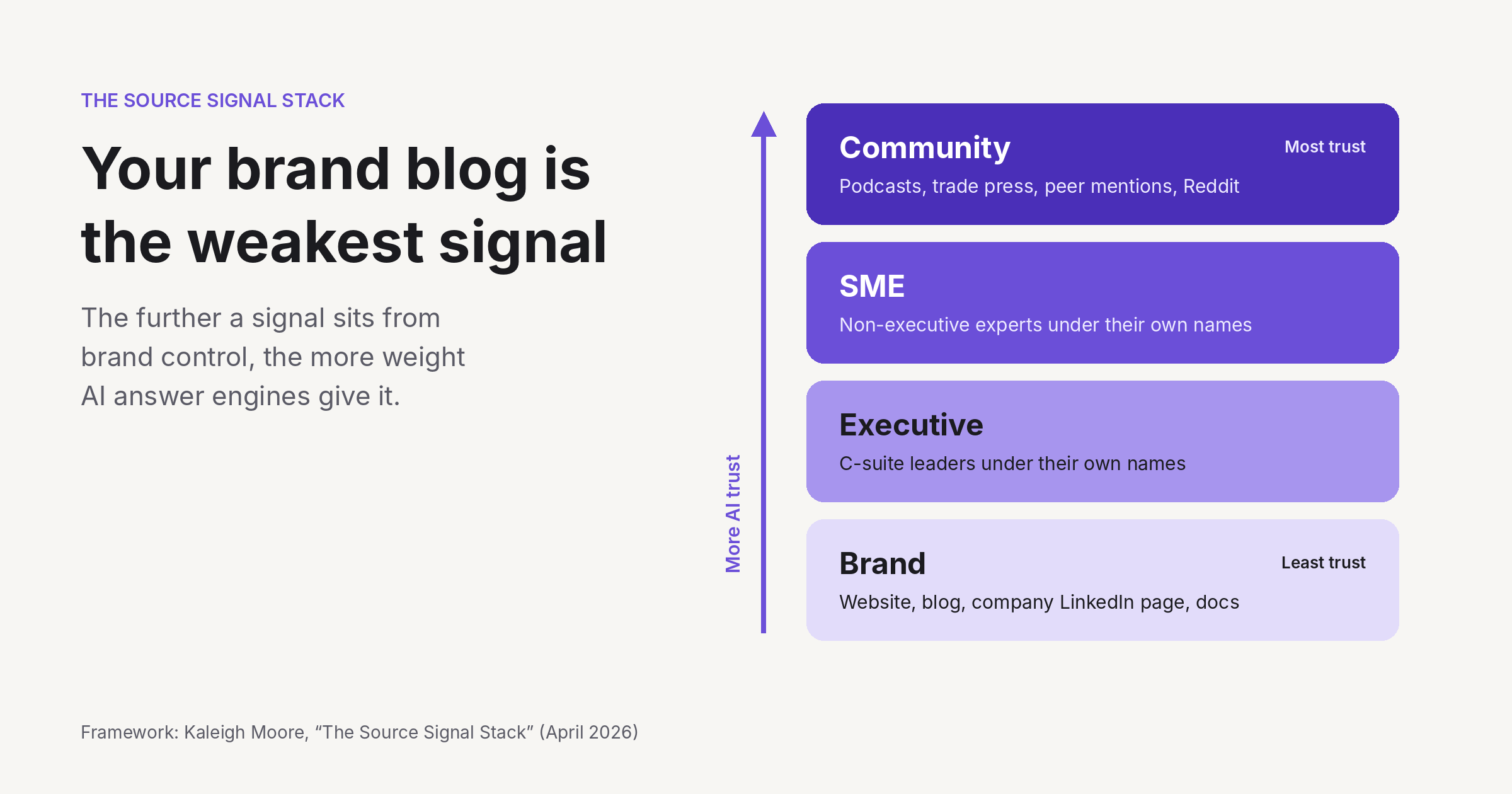
She calls it the Source Signal Stack, and she published it in April. Her core rule is simple: the further a signal originates from brand control the more weight LLMs give it.
If that's true a lot of AEO budget is going to the wrong layer.
The four layers
| Layer | What it is | How much AI trusts it |
| Brand | Your website, blog, company LinkedIn page and documentation | Least |
| Executive | Your C-suite publishing under their own names | More, but still seen as aligned with the brand |
| SME | Non-executive experts publishing under their own names: product managers, solutions engineers, customer success leads | More again. She calls it the unclaimed opportunity |
| Community | Earned coverage: podcasts, trade press, peer mentions, Reddit threads | Most |
Two details make this practical.
First, her test for the brand layer: if you removed the company name, would the remaining content still tell an LLM who you are and what you know? A lot of corporate blogs would fail that test.
Second, LLMs cross-verify. They look for the same claim from several independent sources before citing one, so a single named voice only goes so far. She wants every signal to attach a dateable, defensible claim to a named person.
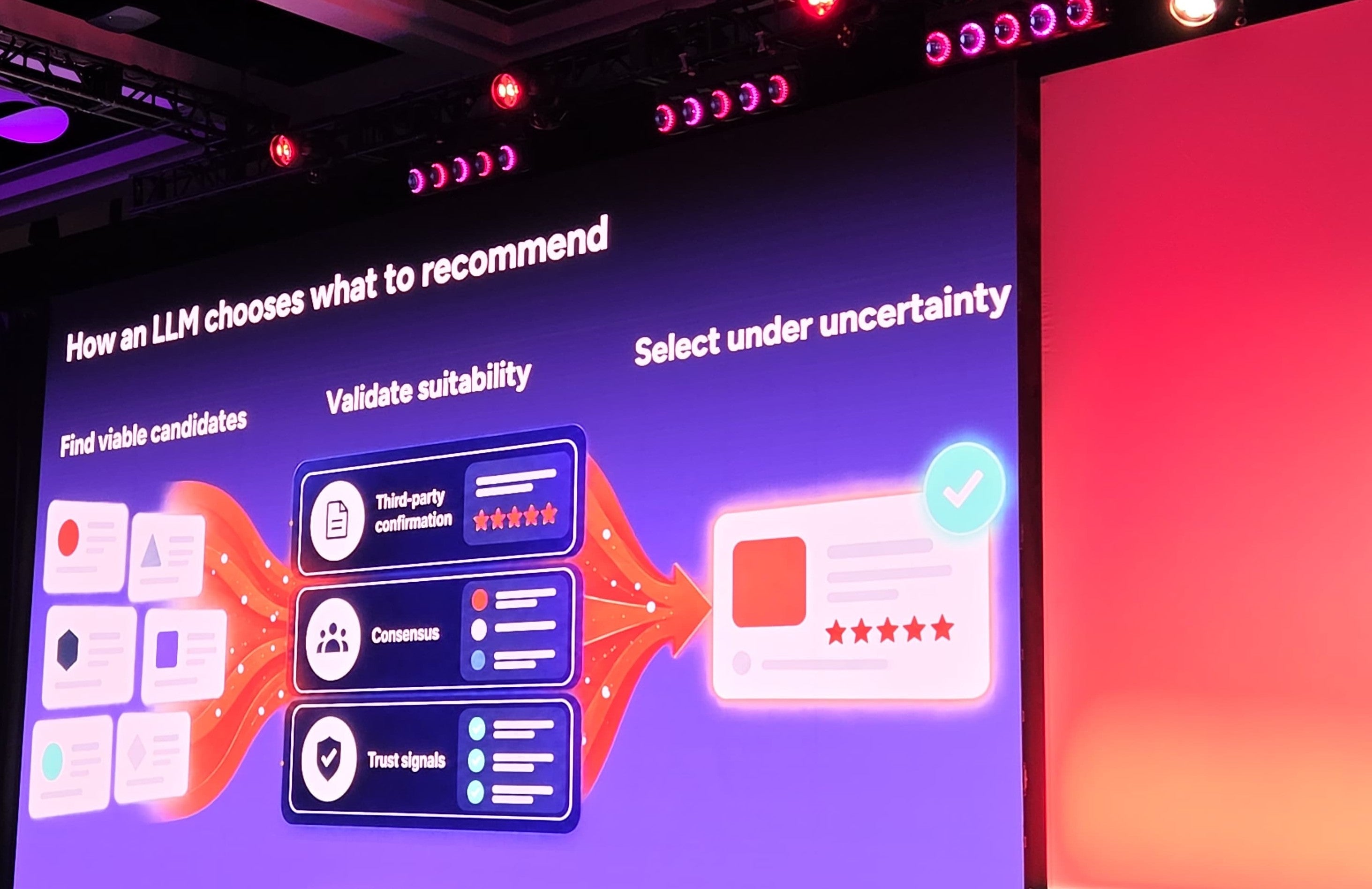
She backs this with third party research. Among the studies she cites a Profound analysis of 1.4 million AI citations found 59% of cited LinkedIn content came from individual members not company pages. A Muck Rack analysis found over 85% of AI-cited links come from earned coverage.
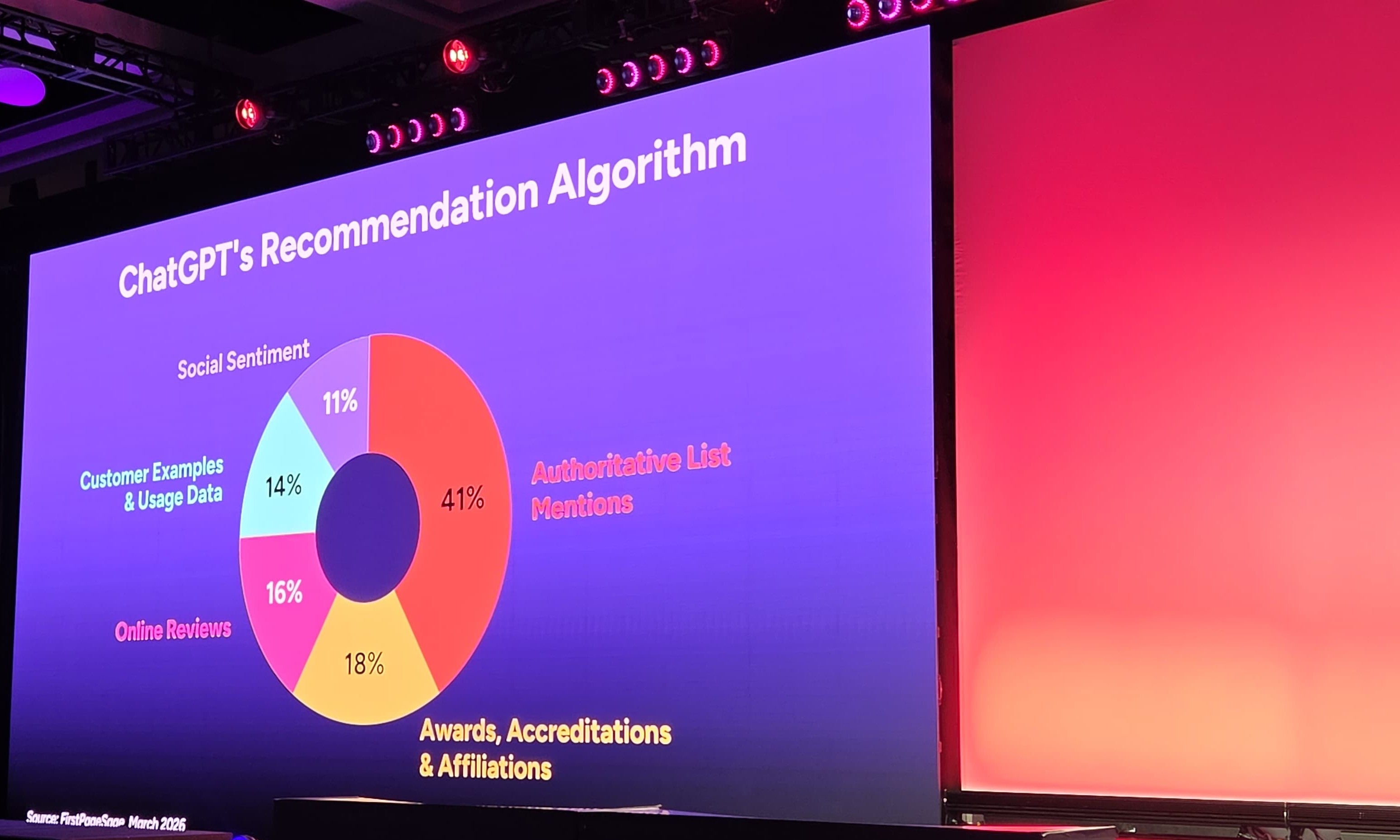
It also lines up with Tim Sanders' Symposium keynote. In the FirstPageSage breakdown on his slide nearly every factor behind ChatGPT's recommendations came from what other people say about you.
What the stack looks like for a Sitecore team
Map it onto a typical enterprise marketing team and the gaps show up fast.
Brand. Usually strong. A well-built Sitecore site with product pages, documentation and a blog. This is where most of the content budget already goes.
Executive. Hit or miss. Sometimes a CMO who posts, often nobody.
SME. Almost always empty. The people who actually know the product, the architects, product owners and content leads, rarely publish under their own names. Their knowledge ends up on the brand blog with no byline, which puts it right back in the weakest layer.
Community. Whatever happens to happen. A conference talk here, a partner case study there.
The fix is not more content. Kaleigh argues a full stack beats a brand-only program producing five times the volume. The fix is moving some of what you already know out of the brand layer and into named people.
For Sitecore teams there's a second job: making the brand layer machine-readable so what your experts say can be checked against your site. Clean product facts, schema and pages an agent can parse. A named expert says it. Your site proves it. That's how the layers back each other up.
The MVP angle
I've been a Sitecore MVP for a while, and honestly this framework reads like a description of the MVP program.
For Sitecore as a vendor MVPs are community signals. They're independent named experts with years of dated specific claims about the platform. For the partners and customers who employ them they're SME signals. The same person counts twice depending on whose stack you're looking at.
And the community layer around Sitecore is unusually deep. User groups, SUGCON, the Sitecore Slack community, hackathons, podcasts and a gazillion blog posts. That's earned, third party, cross-verifiable content about the platform and the people who work on it.
I've always said MVP is a consequence of what you do, not the goal. Kaleigh's framework explains why that matters for AI search. The program never set out to be an AEO strategy. It just rewards the behavior the stack needs: specific people, sharing what they know, for years.
The lesson for customers and partners is the same. Your best AEO asset might already be on your payroll. They just aren't publishing yet.
Where to start this quarter
Kaleigh's recommendations are concrete, so I'll borrow the parts that fit a Sitecore team:
- Run her 15-minute diagnostic. Search your company, your CEO and three of your experts in ChatGPT and Perplexity. Then count third party mentions of your people in the last 90 days.
- Pick three to five experts, not fifteen. She argues three people publishing consistently for twelve months beat fifteen publishing on and off. Pick people with a real point of view who actually want to do it.
- Interview them instead of assigning homework. Her method is a 45-minute conversation that yields three to five insights, with the expert keeping their voice and final approval.
- Fix the brand layer so it backs them up. Run her test. Strip your company name from your top pages and see if they still say anything specific.
- Be patient. She expects 9 to 12 months before citation rates move meaningfully.
The hardest part isn't the content. It's getting a company comfortable with its experts having their own names and opinions in public. That's a culture decision more than a marketing one.
Who on your team knows the most and has never published a word?
Sources

Akshay Sura
Akshay is a ten-time Sitecore MVP and a two-time Kontent.ai. In addition to his work as a solution architect, Akshay is also one of the founders of SUGCON North America 2015, SUGCON India 2018 & 2019, Unofficial Sitecore Training, and Sitecore Slack.
Akshay founded and continues to run the Sitecore Hackathon. As one of the founding partners of Konabos Consulting, Akshay will continue to work with clients, leading projects and mentoring their existing teams.
Share on social media