Sitecore Symposium 2026: Tim Sanders on Winning the Answer
Akshay Sura - Partner
18 Nov 2026
Why this session stuck with me
I go to Symposium for the people. This year one keynote changed how I think about a question that now comes up in almost every client conversation: how do we show up in AI answers?
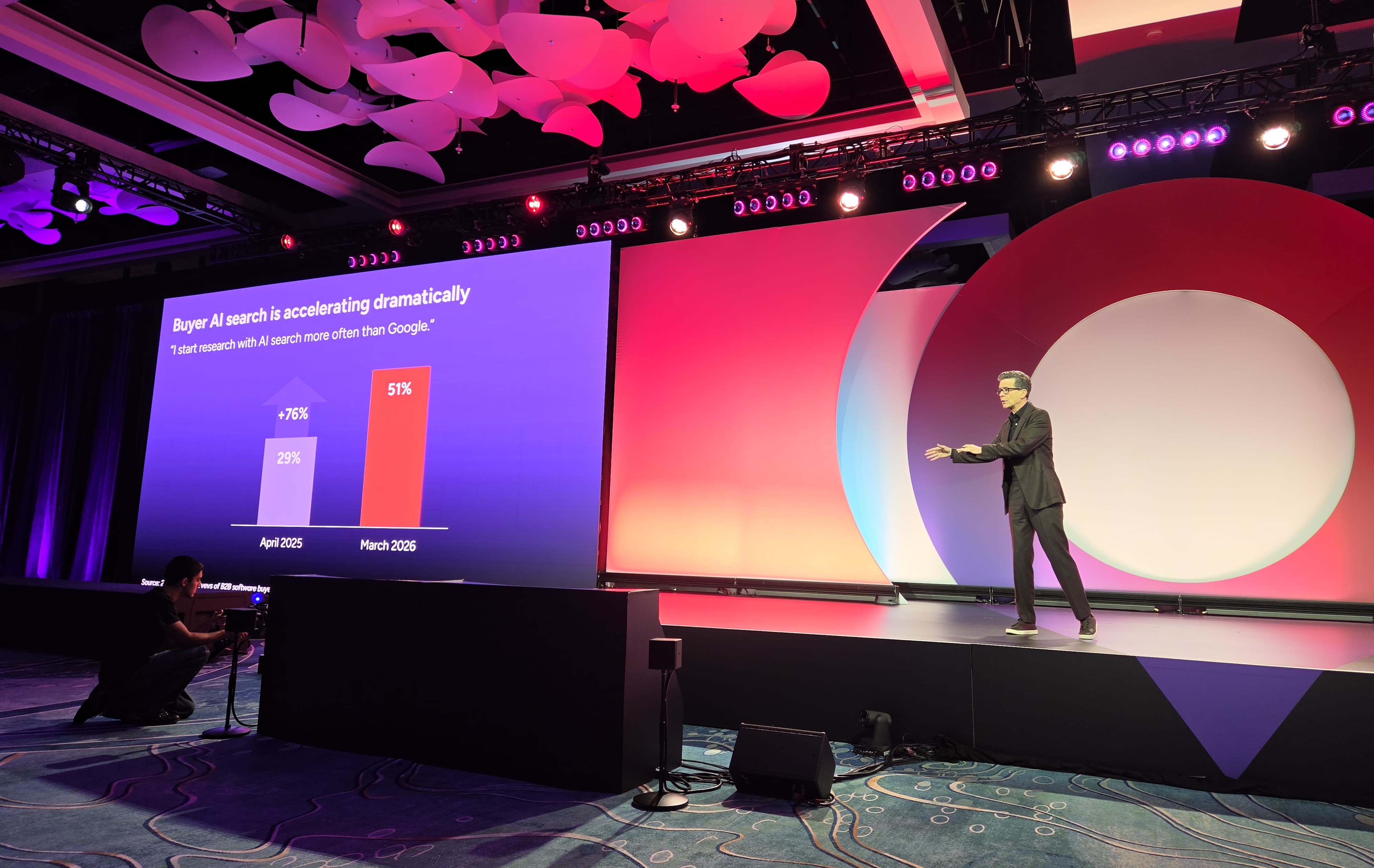
Tim Sanders is Chief Innovation Officer at G2 and the author of Love Is the Killer App. His talk was called "Winning in the age of answer engines." G2 has an interesting seat for this topic. Buyers go there to compare, software and AI tools pull from it when they recommend software.
None of this was new territory for Tim. He has been building the same argument for about two years. He talked about "the answer economy" at G2's Reach conference in 2024, presented G2's AEO research at AEO Conf and walked through the same third party weighting on the Eye on AI podcast in September 2026. Symposium got the latest version, with fresh G2 data behind it.
His core point was simple. Showing up in an AI answer is the easy part. Getting recommended is what moves pipeline and that takes evidence someone other than you can verify.
Buyers start with AI now
The data behind his talk comes from G2's own research. The main source is The Answer Economy, a March 2026 survey of 1,076 B2B software buyers and decision-makers. The numbers moved faster than I expected.
In G2's 2025 Buyer Behavior Report, 29% of buyers said they start research with an AI chatbot more often than Google. By March 2026, it was 51%. That's a 76% jump in about a year. And 71% now rely on AI chatbots somewhere in their research.
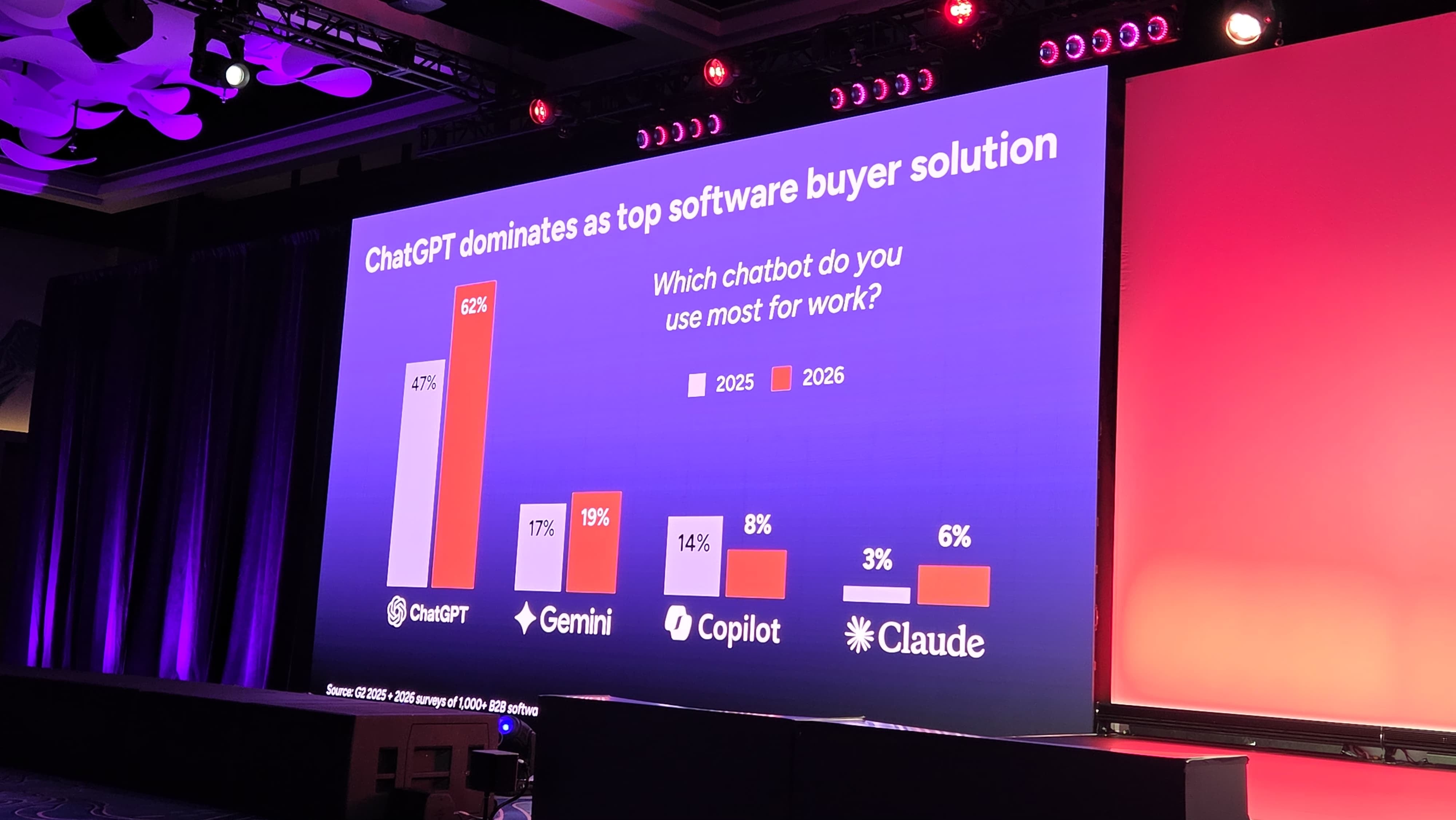
Most of that happens in ChatGPT. Asked which chatbot they use most for work, 62% of buyers said ChatGPT in 2026, up from 47% the year before. Gemini went from 17% to 19%, Copilot dropped from 14% to 8% and Claude doubled from 3% to 6%.
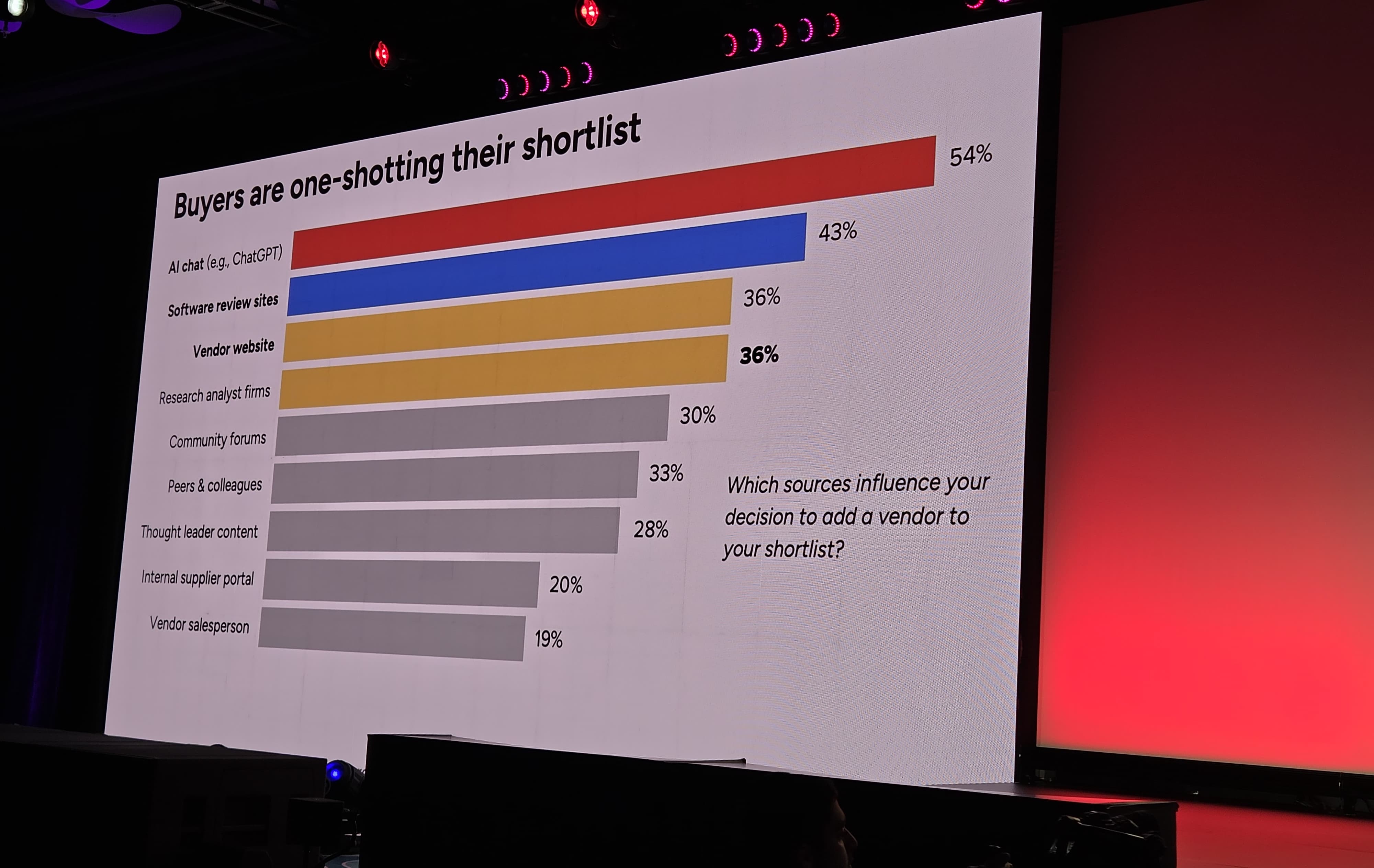
Another slide was about the shortlist. In the same survey, buyers were asked which sources influence adding a vendor to their shortlist. AI chat came first at 54%. Software review sites were next at 43%. The vendor's own website and research analyst firms were both at 36%. The vendor salesperson came last at 19%.
Tim called it buyers "one-shotting their shortlist." Think about what that means. If the shortlist gets built in a chat window, a lot of vendors are out before anyone visits their website.
AI starts the journey. It doesn't finish it.
This is the part that gets lost in the headlines. Buyers have not walked away from Google or from your website.
In the same March survey, 61% of buyers said they use AI search and Google together and 80% still use Google somewhere in their buying journey. The vendor's own website still influenced 36% of shortlists. AI is where the shortlist starts. Search, review sites and your website are where buyers check it.
AI does change what happens next. 85% of buyers think more highly of a vendor that AI cites in its answer. 69% said an AI chatbot led them to a different vendor than they first planned and 33% bought from a vendor they had never heard of before.
G2's 2026 Buyer Behavior Report, a separate June 2026 survey of 1,038 decision-makers, fills in the back half. 82% sourced software recommendations from an AI chatbot in the last two years. But when asked what shapes the shortlist, review sites (38%) edged out AI chatbots (37%) for the first time. Buyers who used AI for recommendations were also more likely to buy from their first shortlist: 80% did so in at least three of their last five purchases, compared to 65% of buyers who didn't. Getting on that first list matters more than it used to.
Once you are on it, the work gets harder. Evaluation is now the longest stage of the buying journey for 40% of buyers, ahead of research at 36%. IT security review is the single biggest source of delay, named by 39% of buyers. Nearly half say a CFO vetoed a purchase that was already approved. G2 sums up Tim’s take in its writeup of the report: AI has solved one constraint but created a new one.
So AI gets you considered. Your website and the proof behind it get you through security and finance. You need both.
The question got longer
Tim put two searches side by side. The Google version was "best CRM for hospitals." The chat version read like a procurement brief: an affordable solution for patient scheduling, messaging and reimbursement processing, one that works as well on mobile as on desktop because many staff are also medical providers and no vendors that require a contract of a year or longer.
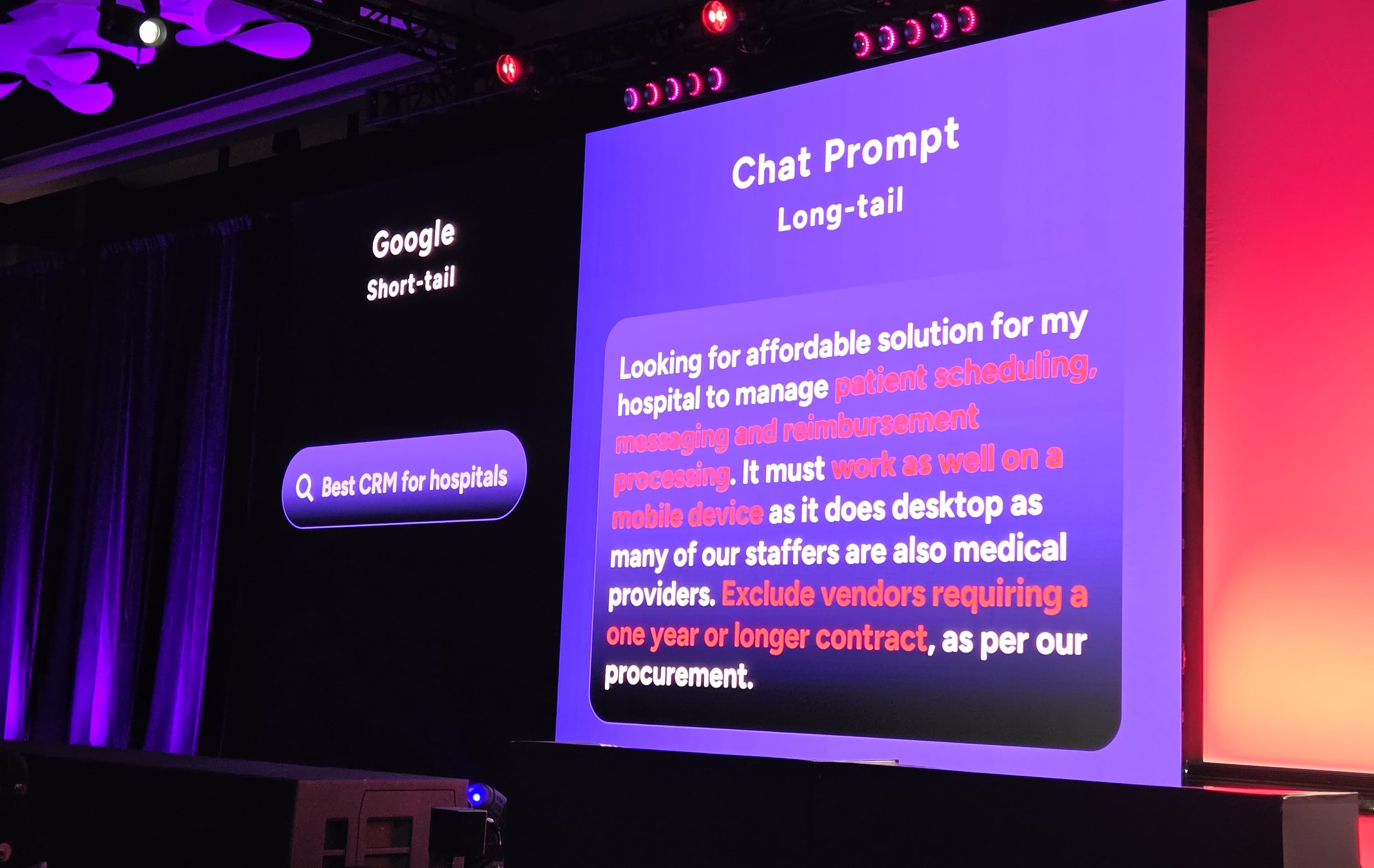
That second prompt carries constraints a keyword never did. Either your product matches them in the AI's view, or it gets filtered out. This is why ranking for a keyword and getting recommended are two different problems.
How an LLM decides what to recommend
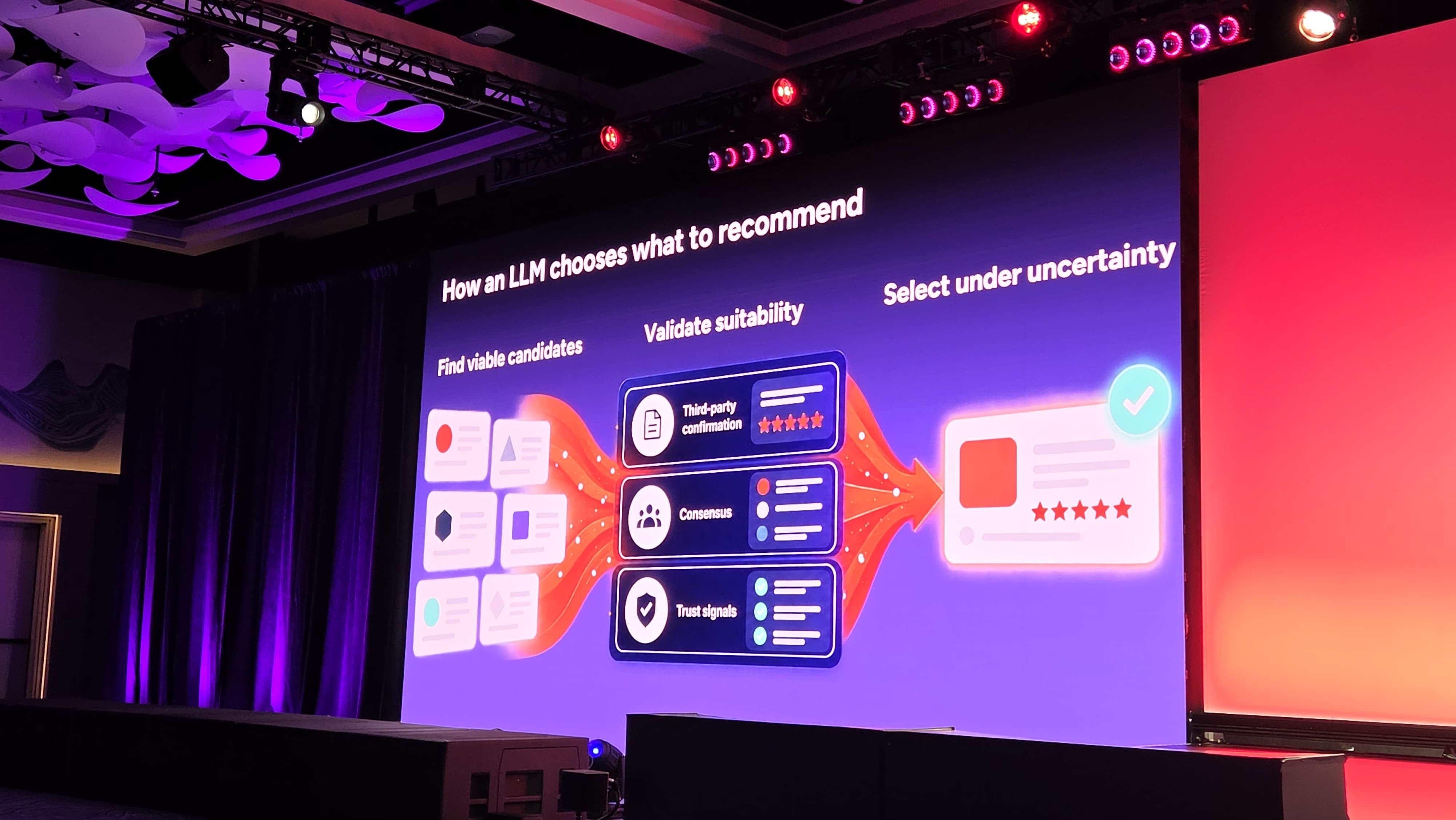
Tim described the model's process in three steps. It finds viable candidates. It checks whether each one fits, using third party confirmation, consensus across sources and trust signals. Then it picks one under uncertainty.
He also showed a FirstPageSage breakdown (March 2026) of what drives ChatGPT's recommendations. Authoritative list mentions were 41%, awards, accreditations and affiliations 18%, online reviews 16%, customer examples and usage data 14% and social sentiment 11%. One caveat. OpenAI doesn't publish how ChatGPT ranks anything, so treat this as FirstPageSage's model, not the actual algorithm. The direction still matches the rest of the talk. Almost all of it is about what other people say about you.
The slide I keep coming back to used dumbbells. A mention weighs 2 pounds. A citation weighs 5. A branded citation weighs 10. Being the recommended solution weighs 50, with the caption "You won the answer!" Most AEO reporting I see counts the 2 and 5 pound weights. Pipeline comes from the 50.
There's data behind the metaphor. On the Eye on AI podcast in September, Tim cited PromptWatch figures: a citation sitting next to a recommendation earns a 1 to 7% click-through rate, while an ordinary citation gets a fraction of 1%.
Then this line: "Humans reward helpful content with product consideration. Agents separate the publishing entity from the product entity." For years the playbook was to write helpful content, earn trust and get considered. A person who loves your blog post gives your product some credit for it. An agent doesn't make that jump. Your blog can get cited as a source while your product never gets recommended.
You probably have an evidence problem
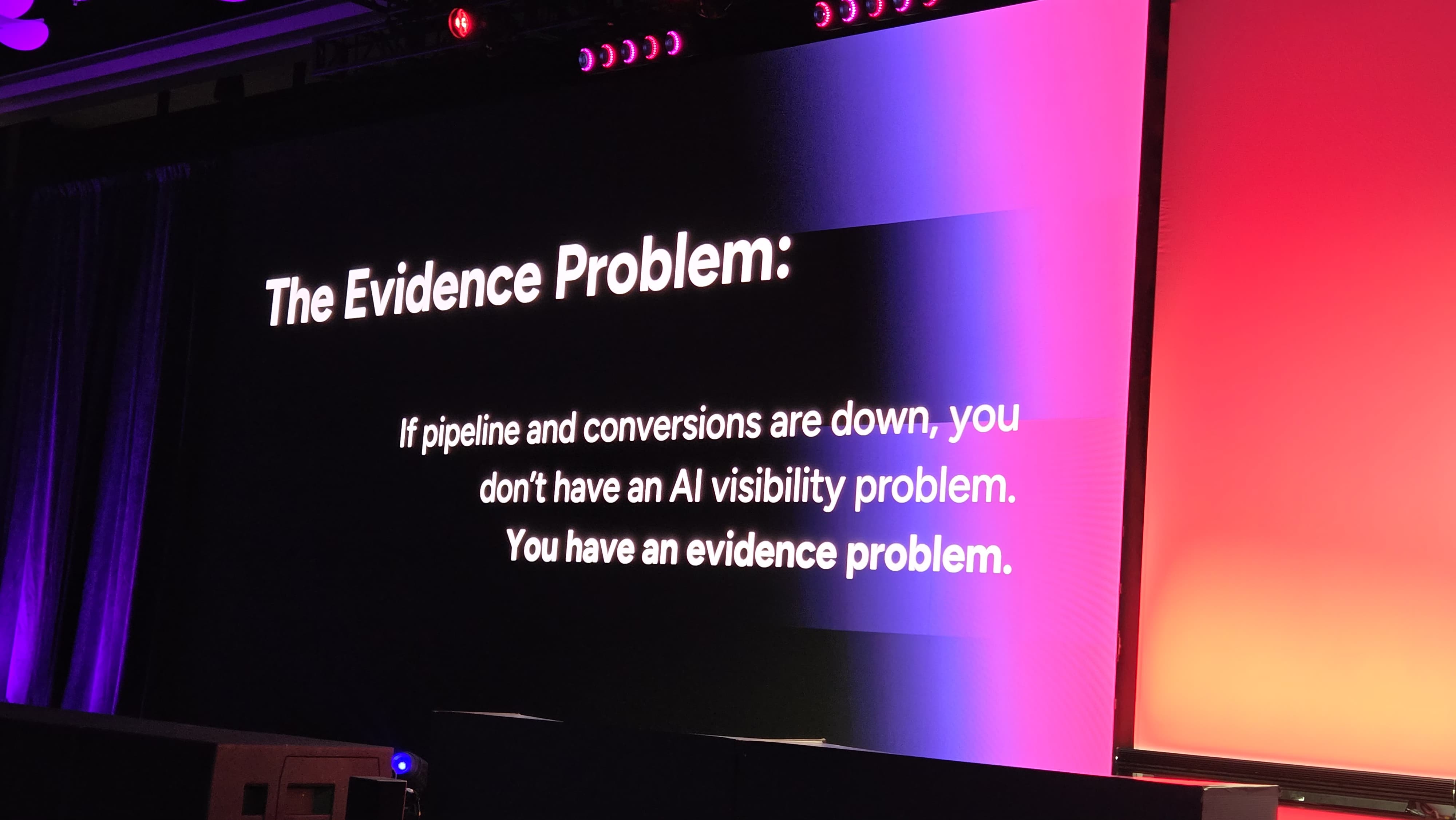
Tim's sharpest slide said it plainly: "If pipeline and conversions are down, you don't have an AI visibility problem. You have an evidence problem."
He broke the work into three problems, each with one question:
- Prompt problem. Are you tracking what buyers actually ask?
- Evidence problem. Can a third party verify your claims?
- Reallocation problem. Is your budget where your buyers are?
The second one is uncomfortable. A lot of B2B websites are full of claims nobody outside the company backs up. An agent checks those claims against reviews, lists, analyst coverage and customer stories. If that proof doesn't exist, the claim doesn't count.
What he told us to do
For the prompt problem, Tim walked through how to build a synthetic persona, a stand-in for your buyer that you can use to write and test realistic prompts. His model has five parts. The job they are trying to get done. Their constraints, meaning time, risk, compliance, budget and tooling. Their success metrics, or what "good enough" looks like to them. Their decision criteria, the proof they need before they trust you and act. And their vocabulary, how they naturally talk.
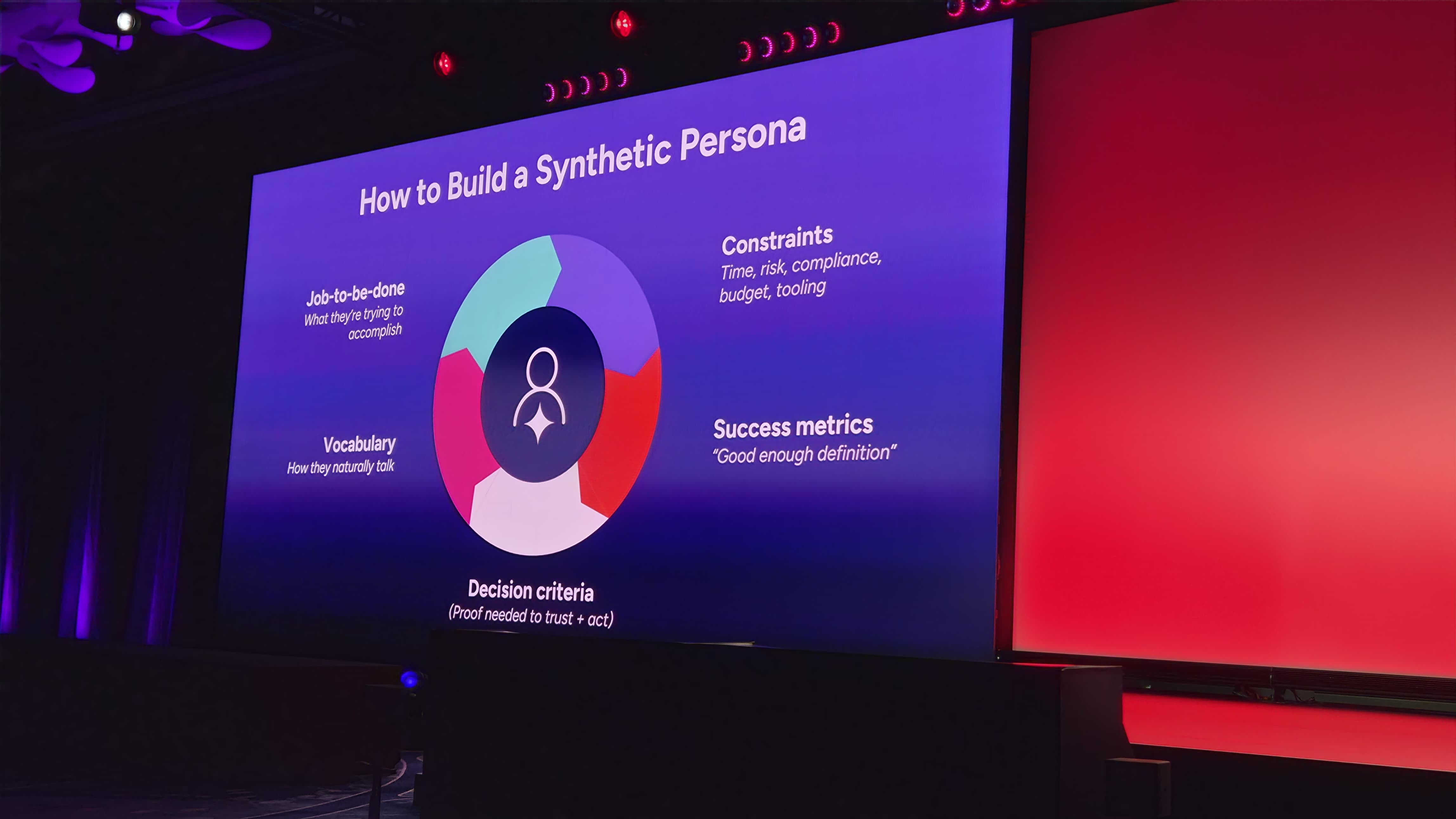
That last one matters more than it looks. Buyers don't prompt in your product's terminology.
For the reallocation problem, he shared a suggested split for AEO budget in 2026:
| Area | Share of AEO budget |
| Content restructuring and original authority content | 40 to 45% |
| Third party proof | 20 to 25% |
| Technical crawlability, schema, feeds and agent readiness | 15 to 20% |
| Measurement tools and dashboards | 10 to 15% |
| Experiments and platform specific tests | 5 to 10% |
Measurement is one of the smallest slices. Yet most teams I talk to spend their first AEO dollars on dashboards. A dashboard tells you where you stand. Everything else in that chart is what changes it.
Tim is not telling anyone to blow up their search budget either. In the Eye on AI interview he estimated that companies spend about $60 on search for every $1 on AEO. He suggested growing AEO gradually, maybe to 4 to 6% of budgets this year, because the tools are still immature.
What this means for Sitecore teams
Tim gave one of the most practical keynotes I've seen on AEO. It's also fair to say G2 has an interest in this message. A talk arguing that third party proof and review sites decide the shortlist comes from a company that runs a large software review site. I don't think that makes the data wrong. I'd just read it knowing who is presenting it.
The technical slice is the part implementation partners like us own. Schema, feeds, crawlable pages and product facts an agent can read cleanly all live inside your Sitecore build. If your SitecoreAI or XP implementation buries product facts in components an agent can't parse, no amount of thought leadership fixes that. Sitecore clearly agrees on the direction. It spent a lot of Symposium on Scrunch and MarketingIQ. At the MVP Summit, one of its own slides put it plainly: "Fewer visits does not mean less influence." Your site becomes a trusted input to journeys that happen elsewhere.
The evidence slice is something no CMS can produce for you. Reviews, analyst coverage, partner listings, awards and named experts publishing under their own names all happen outside your website. That is the slice I'd tell marketing teams to start on now, because it takes the longest to build.
There's a personal angle too. Awards, accreditations and affiliations showed up at 18% in that FirstPageSage breakdown. I've been a Sitecore MVP every year since 2017 and I have always said MVP is a consequence of what you do, not the goal. Agents seem to look at the same thing. They care about what others have verified about you, not what you say about yourself.
If you want one number to track, track recommendations, not mentions. Pick a fixed set of real buyer prompts, run them across the engines your buyers use and count how often you are actually put forward as an option. Tim made the same point about method. AI answers vary from run to run, so one manual check tells you nothing. You need a panel of prompts, run at volume, over time.
If you're working on AEO right now, what are you actually measuring: mentions, or recommendations?
Sources
- G2: In the Answer Economy, Don't Win the Click, Win the Answer (April 15, 2026)
- G2 2026 Buyer Behavior Report: The Evaluation Maze
- G2: AI Is Reshaping How B2B Software Deals Are Won and Lost (July 22, 2026)
- Scuttlebutt: Tim Sanders on Eye on AI (September 15, 2026)
- G2 Reach 2024 agenda
- AEO Conf: How Answer Engines Shape B2B Software Buying Decisions
- Slides from Tim Sanders' keynote, Sitecore Symposium 2026 (photographed by Balaji Kandasamy)

Akshay Sura
Akshay is a ten-time Sitecore MVP and a two-time Kontent.ai. In addition to his work as a solution architect, Akshay is also one of the founders of SUGCON North America 2015, SUGCON India 2018 & 2019, Unofficial Sitecore Training, and Sitecore Slack.
Akshay founded and continues to run the Sitecore Hackathon. As one of the founding partners of Konabos Consulting, Akshay will continue to work with clients, leading projects and mentoring their existing teams.
Share on social media