
Traffic only tells part of the story
Akshay Sura - Partner
20 Nov 2026
The report still leads with traffic
Open most quarterly marketing reports and the first slide is still sessions, then conversions, then channel mix. That made sense when the website was where buyers did their research. It isn't anymore.
In my last post on Tim Sanders' Symposium keynote, the G2 numbers were clear: 51% of B2B software buyers now start research with an AI chatbot more often than Google. A lot of the decision is moving to places your analytics never sees.
At the MVP Summit Sitecore's product team showed a set of slides on exactly this marked for sharing. They're worth walking through because they say out loud what a lot of teams are still avoiding.
Discovery starts before the visit
Sitecore framed the new journey in three steps:
- The question. Someone asks an assistant. Answers can arrive before a click.
- The comparison. An agent compares the options, so your content must be machine-readable.
- The proof. Your site still has to prove it. Facts, evidence and control still matter.
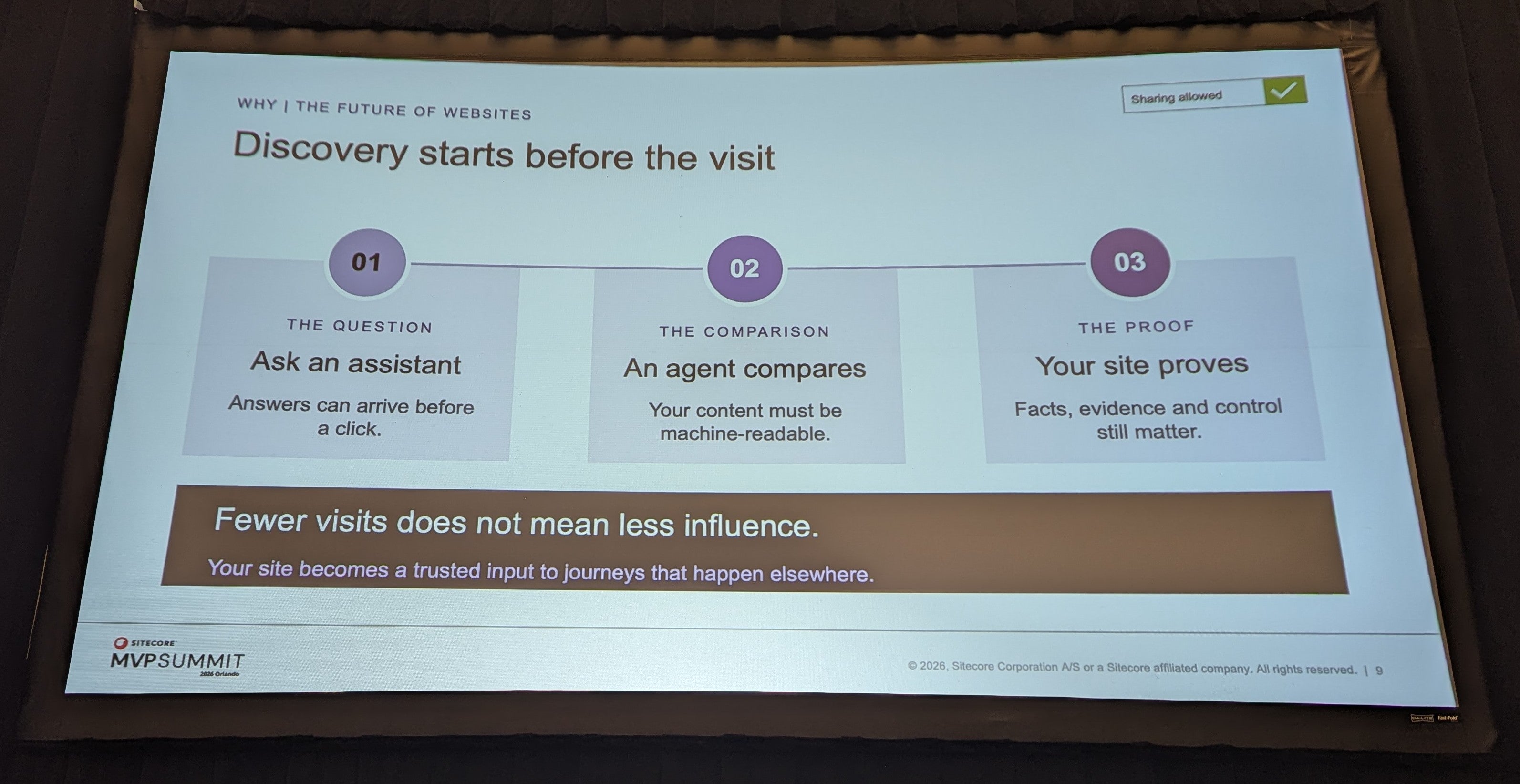
The line under it is the one I keep coming back to: "Fewer visits does not mean less influence." Your site becomes a trusted input to journeys that happen elsewhere.
That's the shift. The website's job moves from destination to source. It still matters maybe more than before but its success shows up in places a session count can't see.
What traffic can't tell you
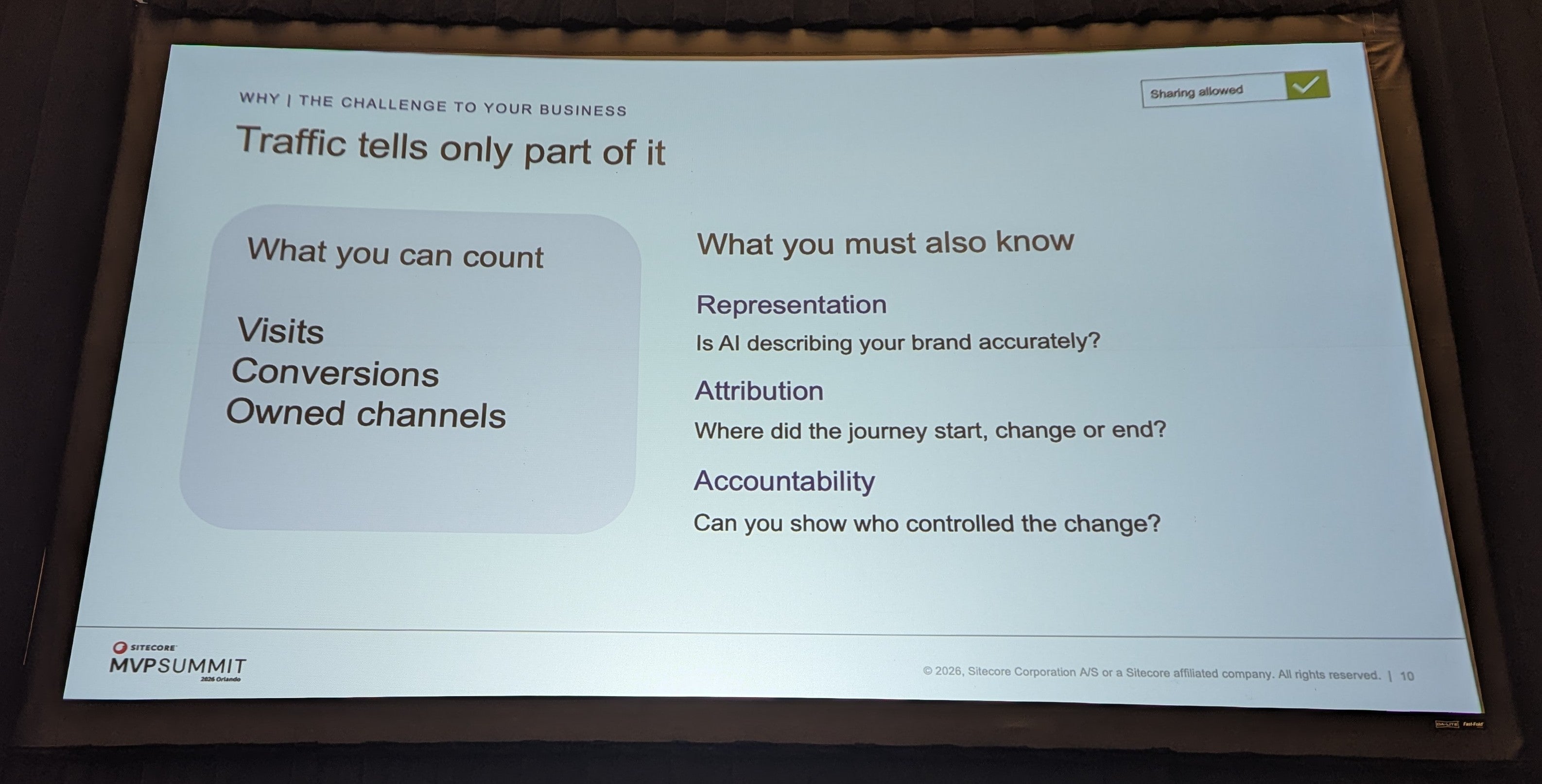
The next slide split reporting into two columns. On the left what you can count: visits, conversions and owned channels. On the right what you must also know:
- Representation. Is AI describing your brand accurately?
- Attribution. Where did the journey start, change or end?
- Accountability. Can you show who controlled the change?
Here's how I'd make each one measurable today.
Representation is the easiest place to start. Pick a fixed set of real buyer prompts and run them across the engines your buyers use every month. Check two things: are you recommended and is what the AI says about you correct? Wrong pricing retired products and old positioning come up more often than people expect. Sitecore's own MarketingIQ announcement uses the same examples: Scrunch catching AI answers that leave a brand out or show outdated pricing.
Attribution is the honest gap. Nobody has fully solved it yet and I'd be wary of any dashboard that claims it has. Report what you can: referral traffic from AI tools branded search trends and a simple "how did you hear about us" field on your forms. Treat it as directional not precise.
Accountability is where Sitecore teams have an advantage if they use it. As AI starts proposing content changes someone will ask who approved a change and whether it can be rolled back. Workflow, versioning and approvals are already in the platform. Sitecore says MarketingIQ keeps people in the approval step too. Its announcement states that nothing leaves a staging area without human involvement. Use that and report on it.
Marketing work needs to change too
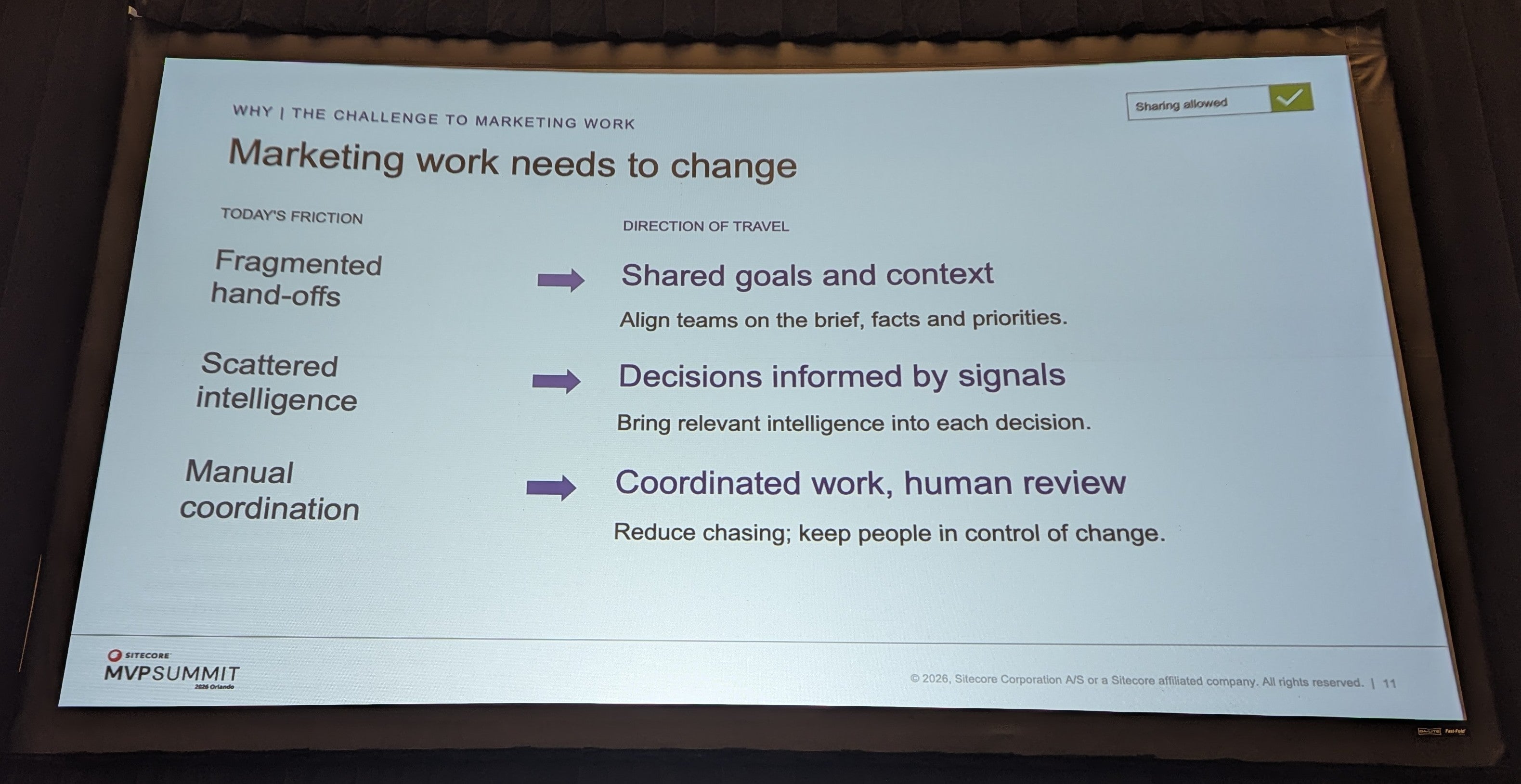
Sitecore paired the measurement slides with a blunt one about how marketing teams operate. Three kinds of friction, and where each needs to go:
| Today's friction | Direction of travel |
| Fragmented hand-offs | Shared goals and context |
| Scattered intelligence | Decisions informed by signals |
| Manual coordination | Coordinated work, human review |
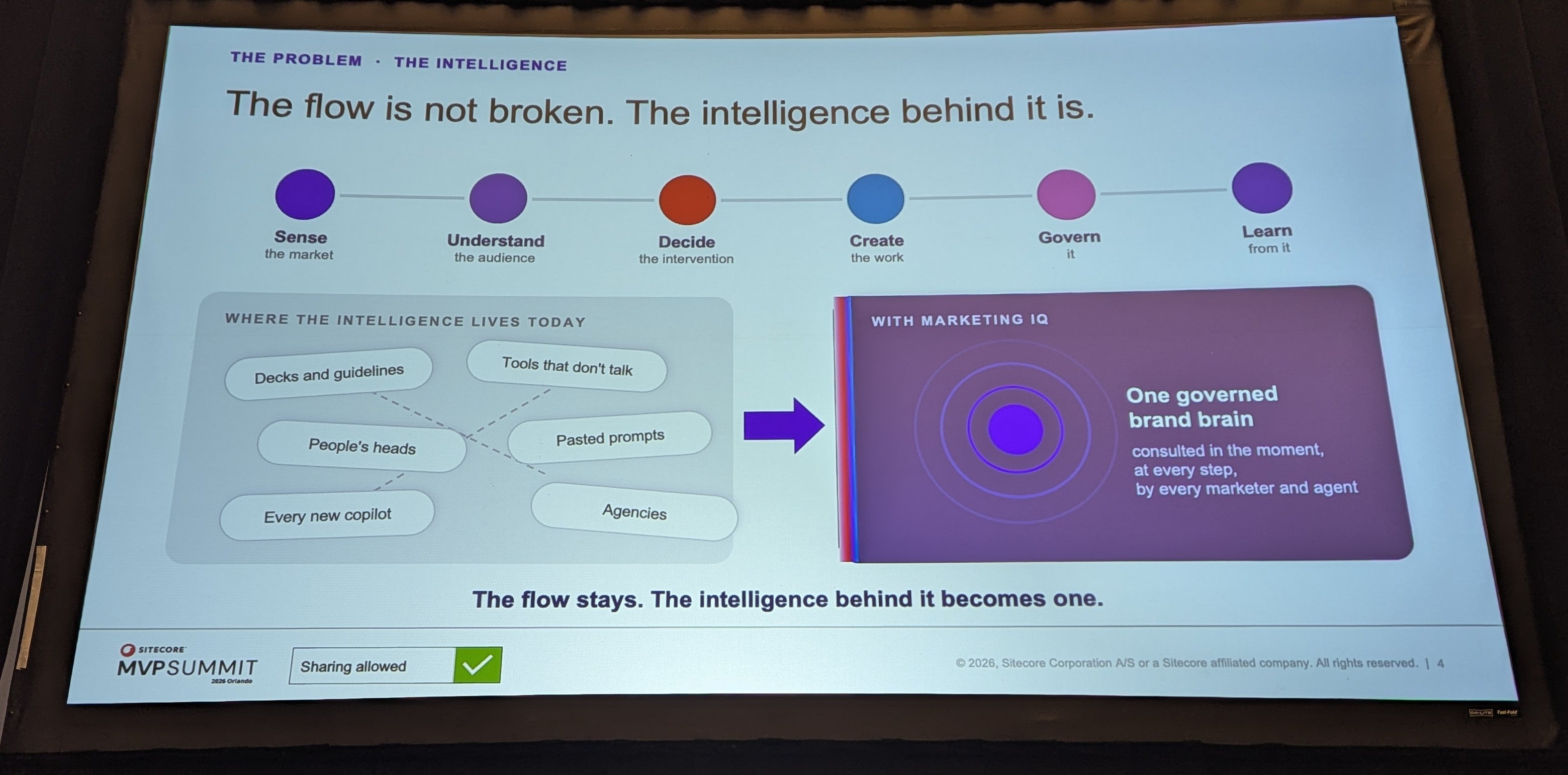
Another slide listed where a team's intelligence lives today: decks and guidelines, tools that don't talk, people's heads, pasted prompts, every new copilot and agencies. Its headline: "The flow is not broken. The intelligence behind it is."
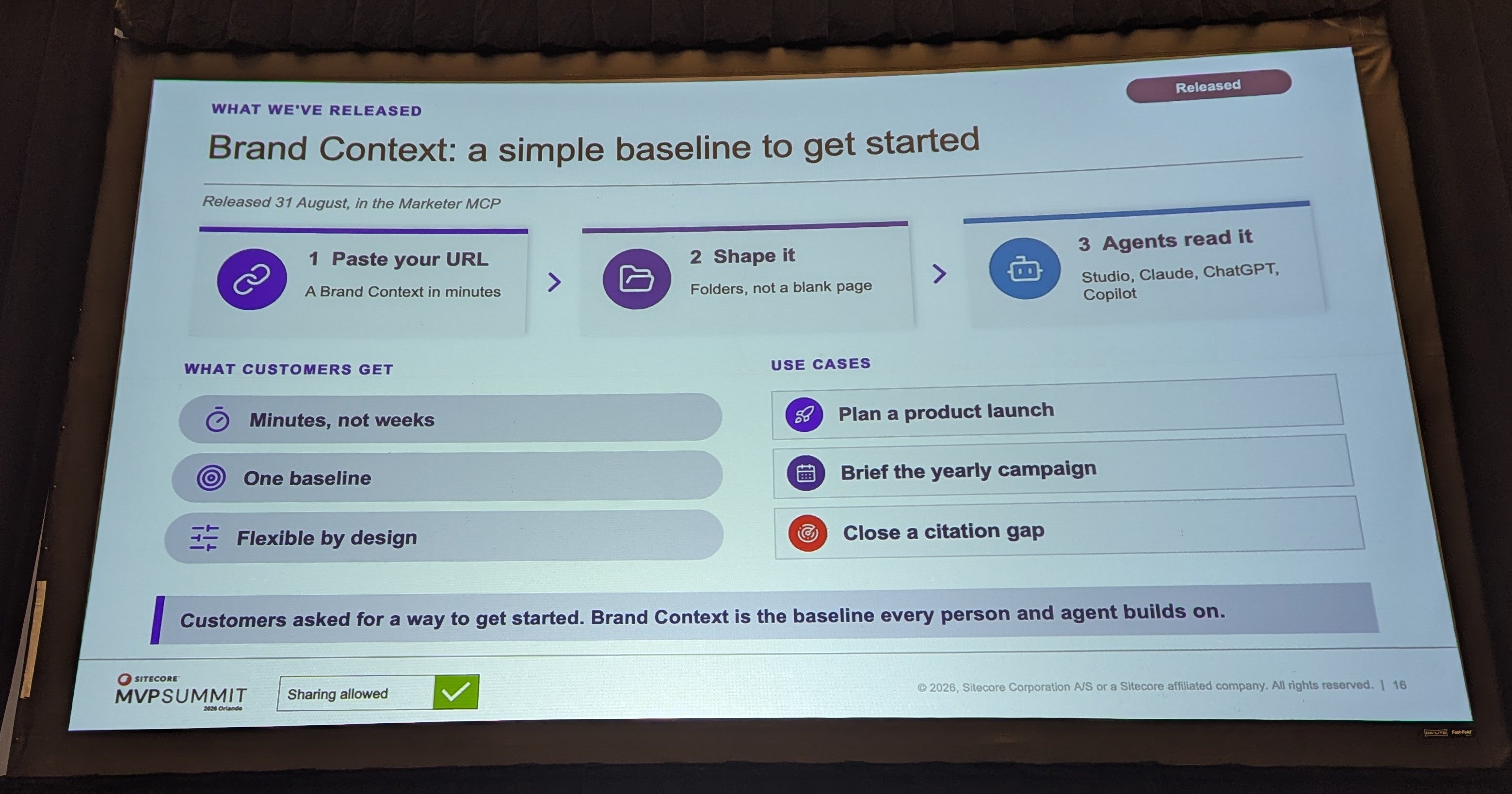
I agree with that more than I expected to. Most teams don't need a new process. They need one version of the brand that every person and every agent works from. Sitecore's answer is Brand Context released August 31 in the Marketer MCP. You paste your URL shape the result in folders and agents like Claude, ChatGPT and Copilot read from it.
Whether a tool fixes it or not the problem is real. If your brand truth lives in six places every AI tool you add makes it worse.
What to put in your next report
If I were rebuilding a Sitecore team's monthly report tomorrow, it would have four parts:
- Traffic and conversions. Still there, just not the headline.
- Recommendation rate. How often you're recommended on a fixed panel of buyer prompts, by engine.
- Accuracy issues. What AI got wrong about you this month, and what you fixed.
- Change log. Every AI-proposed content change, who approved it and whether it was rolled back.
None of this needs new budget to start. A spreadsheet and a few hours a month get you the first three. The fourth is already sitting in your workflow history.
Traffic tells you who showed up. It doesn't tell you who decided without you. That's the part worth reporting on.
What's the first slide in your marketing report right now?
Sources
- Sitecore: Sitecore Introduces MarketingIQ to Turn Brand Intelligence into Business Growth (November 11, 2026)
- G2: In the Answer Economy, Don't Win the Click, Win the Answer (April 15, 2026)
- Konabos: Sitecore Symposium 2026: Tim Sanders on Winning the Answer
- Sitecore slides marked "Sharing allowed," Sitecore MVP Summit 2026 (photographed by Jean-François L'Heureux)

Akshay Sura
Akshay is a ten-time Sitecore MVP and a two-time Kontent.ai. In addition to his work as a solution architect, Akshay is also one of the founders of SUGCON North America 2015, SUGCON India 2018 & 2019, Unofficial Sitecore Training, and Sitecore Slack.
Akshay founded and continues to run the Sitecore Hackathon. As one of the founding partners of Konabos Consulting, Akshay will continue to work with clients, leading projects and mentoring their existing teams.
Share on social media