I pointed two Sitecore AI tools at Konabos. They showed me what our website wasn't saying.
Akshay Sura - Partner
23 Nov 2026
Testing it on ourselves first
I've written a lot lately about AI visibility: Tim Sanders on winning the answer, why traffic only tells part of the story why your brand blog is the weakest signal. At some point you have to stop writing about it and point a tool at your own company.
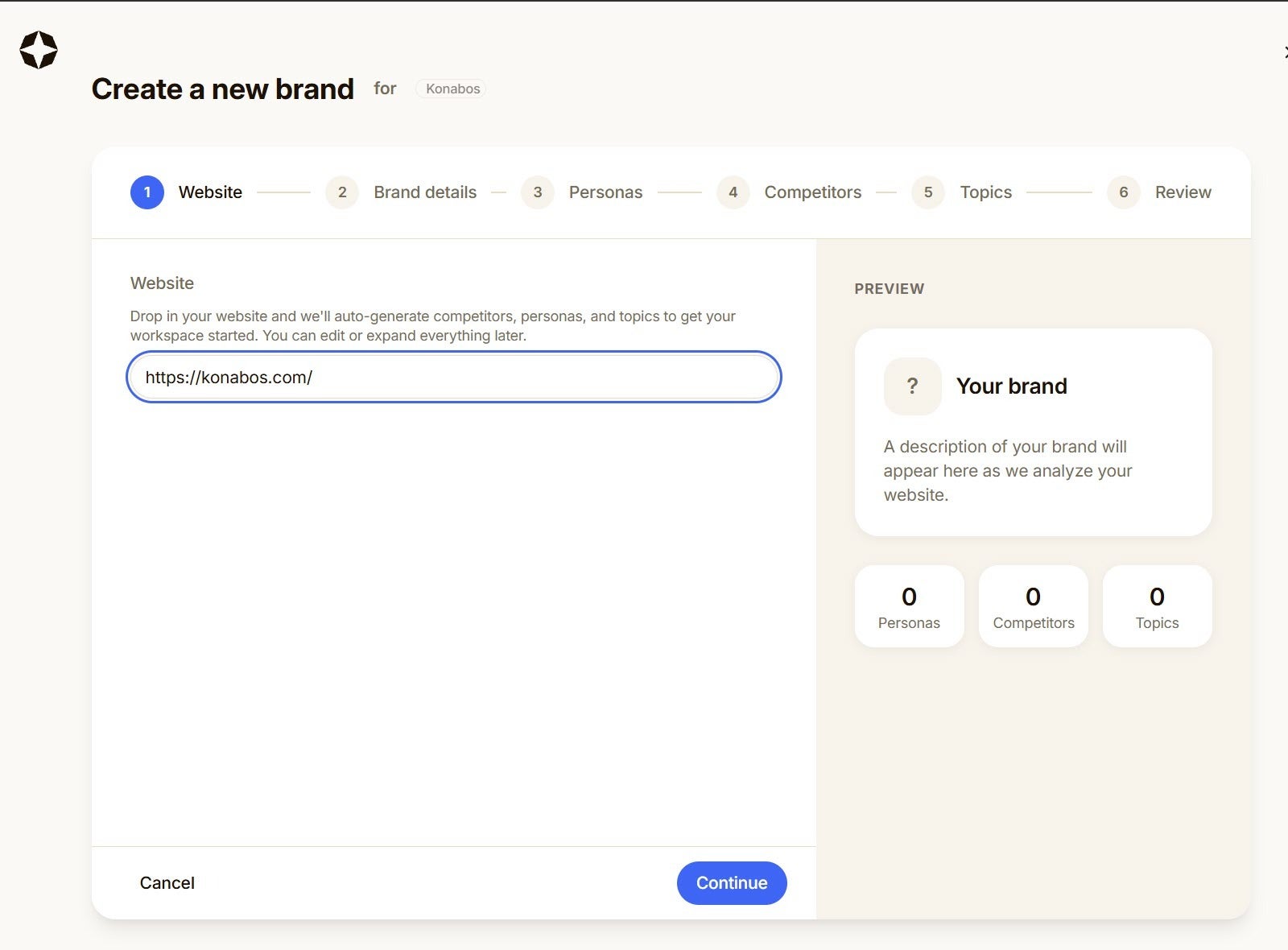
So I set up Scrunch for Konabos. Scrunch is the AI visibility platform Sitecore acquired and it's now built into SitecoreAI. Before I put it in front of a client I wanted to see what it thinks of us.
The setup is genuinely quick. You paste your URL and it drafts everything else: a brand description, personas, competitors and topics. Then you review each step and create the brand. It took me a few minutes.
What it drafted was the interesting part.
What it generated and what it missed
Here's the description it wrote for us word for word:
Offers comprehensive digital agency services that help improve and modernize digital experience platforms, customer interactions, cloud solutions and complex system integrations for large businesses.
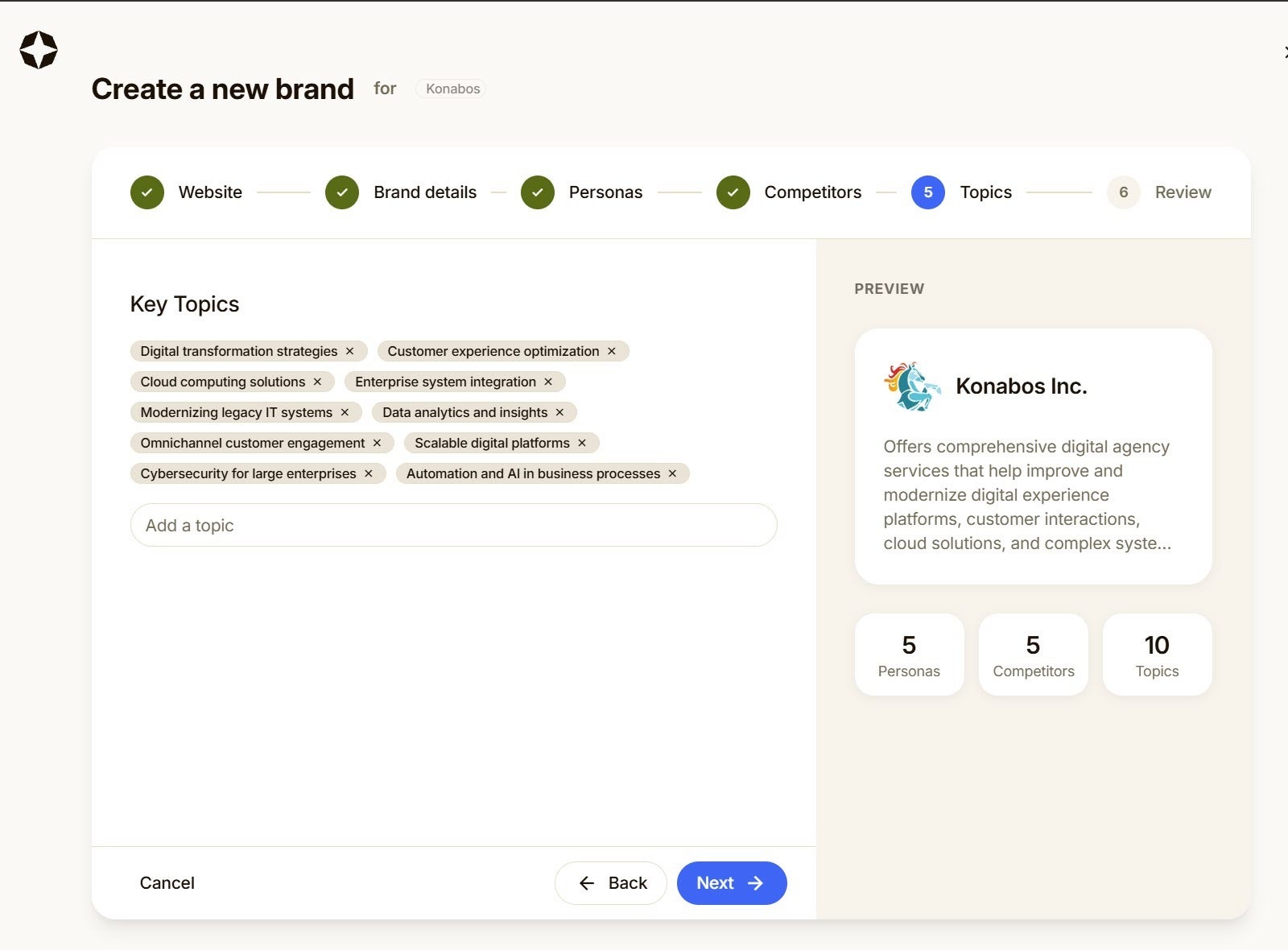
That's a fair summary of what our site says. It's also a sentence that could describe a few hundred agencies. The rest of the setup followed the same pattern:
| What Scrunch drafted | What's missing |
| A generic "digital agency" description | Sitecore. Content Hub. Kontent.ai. The MVPs. Nothing that makes us specific |
| Five personas: Corporate IT Decision Maker, Enterprise Digital Transformation Leader, Cloud Solutions Architect, Customer Experience Manager, Systems Integration Specialist | The marketing and digital leaders who actually own a Sitecore platform and the content teams who live in it |
| Five competitors, all much larger global agencies and integrators | The firms we actually meet in deals |
| Ten topics, from "Digital transformation strategies" to "Cybersecurity for large enterprises" | Sitecore, SitecoreAI migration, headless, DXP, AEO. And we don't sell cybersecurity |
Everything it produced is editable and that's the point of the review steps. But the first draft is a mirror and it's worth looking hard at what it reflects back.
Why that matters: it reads your site the way AI does
It didn't take long to see where that came from.
Scrunch built that draft from our website and whatever else it could find about us. That's roughly what an answer engine does too. If a tool reading konabos.com comes away thinking we're a generic digital agency that does cybersecurity there's a fair chance ChatGPT thinks something similar.
The odd part is that the rest of the web is clear about who we are. Partner listings and press releases describe us as a Sitecore partner, a Content Hub specialized partner and a team led by Sitecore MVPs. Our own site apparently doesn't say it loudly enough.
This is Kaleigh Moore's brand layer test playing out in real life. Strip the company name and ask whether the content still says who you are and what you know. If your positioning is "comprehensive digital services," it doesn't.
And that's the cheapest finding you'll ever get from an AEO tool. Before you track a single prompt the setup screen tells you whether your site is specific enough to be understood.
Generating the first prompts
Next I generated prompts to track. Scrunch lets you draft from scratch with AI or convert a list of SEO keywords. You pick a focus (awareness, evaluation or competitive), optional topics and personas and how many you want.
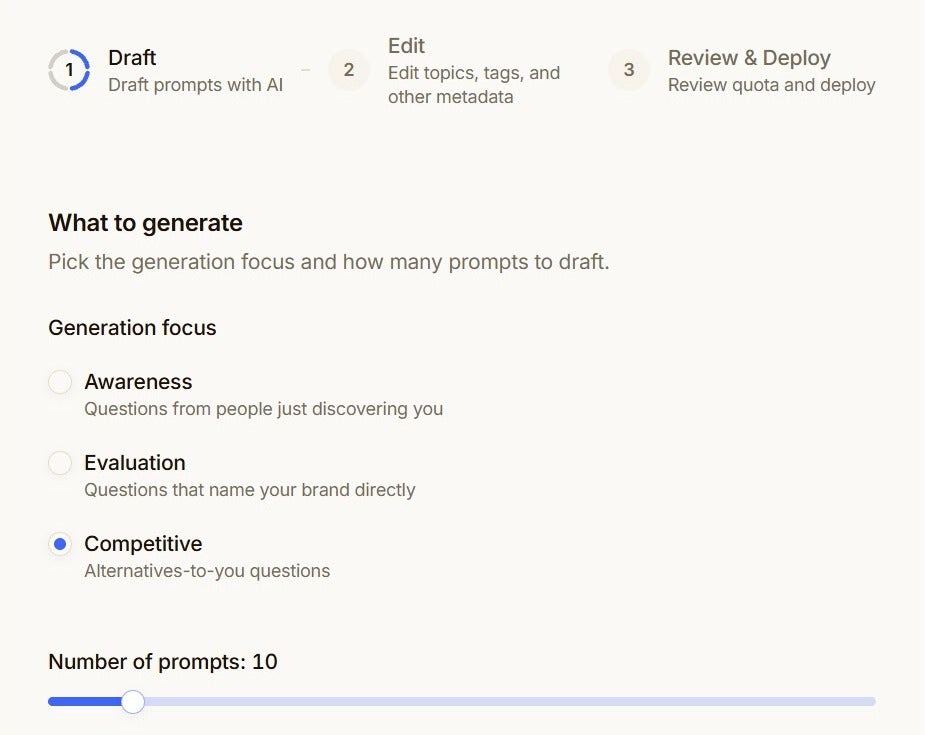
I asked for 10 competitive prompts without giving it any topics. It generated 6 distinct ones and told me why: with no topics to work from there weren't more distinct questions to ask. That's the right behavior and its suggestion to broaden the topics is exactly what I'll do.
The six it drafted were classic competitive questions, "What are some alternatives to <<competitor>>?", one for each competitor it found.
The mechanics after that are clean. Each prompt runs across four AI platforms so 6 prompts became 24 variants with a clear estimate of how many responses that uses each month before you deploy. I like that it shows the math up front.
That's a solid baseline. The next layer is the kind of prompt Tim Sanders showed at Symposium. His example of a real buyer prompt read like a procurement brief: specific requirements, a mobile constraint, no vendors with contracts of a year or longer. Someone shortlisting a Sitecore partner might type something like this:
We're on Sitecore XP and need to move to SitecoreAI within a year without a big-bang rebuild. Which partners have done this for a midsize B2B company and who has Sitecore MVPs on the team?
Scrunch gives you the structure to track both kinds. The long, specific ones have to come from people who know your buyers.
Then I ran Brand Context on the same site
Scrunch shows how an outside reader sums you up. Brand Context in SitecoreAI does a different job: it builds the knowledge your own AI draws on when it writes for you. So I pointed it at konabos.com too.
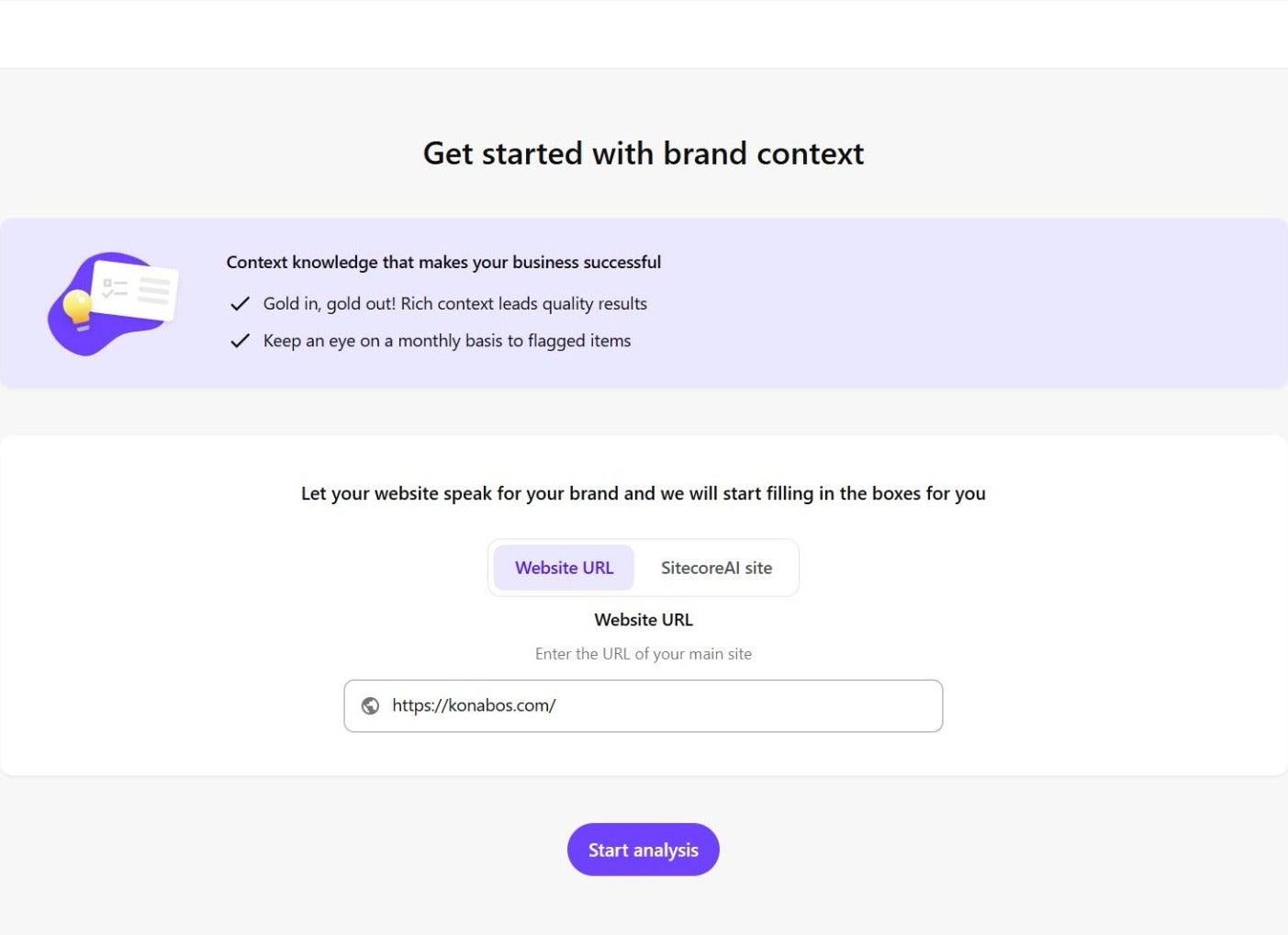
The flow is short. SitecoreAI greets you with a "Brand context is here!" prompt, you choose a website URL or a SitecoreAI site and you click Start analysis. Ours finished in a few minutes.
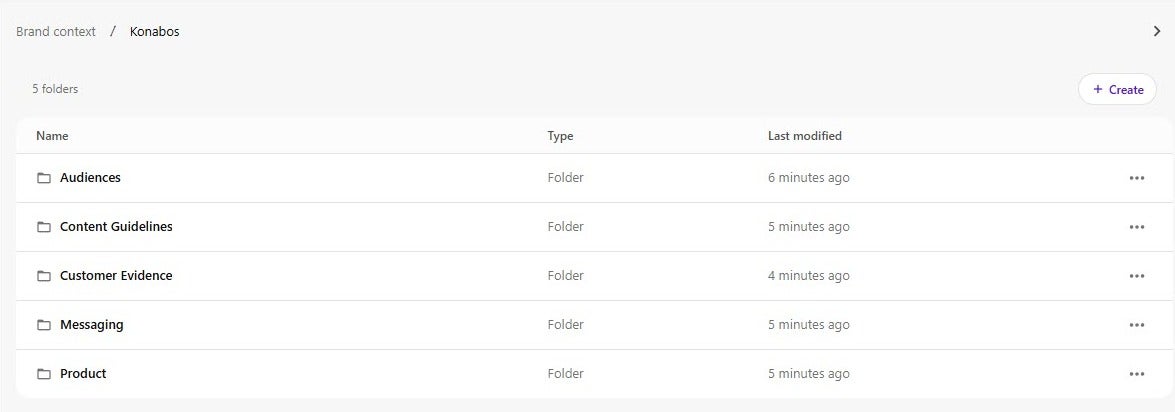
It came back with 18 documents in five folders:
| Folder | What it created |
| Audiences | Audience Strategy, Buyer Journey Map, Industry Verticals, Persona Profiles |
| Content Guidelines | Channel Guide, Content Standards, Style Guide |
| Customer Evidence | Case Studies, Evidence Framework, Success Metrics, Testimonials |
| Messaging | Competitive Positioning, Messaging Framework, Proof Points, Value Propositions |
| Product | Capabilities Matrix, Integrations & Ecosystem, Product Portfolio |
This time the specifics showed up. It listed the platforms we partner on: Sitecore, Kontent.ai, Kentico, Contentstack and Ultra Commerce. It grouped our case studies into the industries we actually work in: building products and manufacturing, healthcare and nonprofit and home care franchising. It mapped a buyer journey from "Why is our experience underperforming?" to "How do we sustain improvement?" and tied our Wayfinder roadmapping service to the early stages. Every section links back to the konabos.com page it came from.
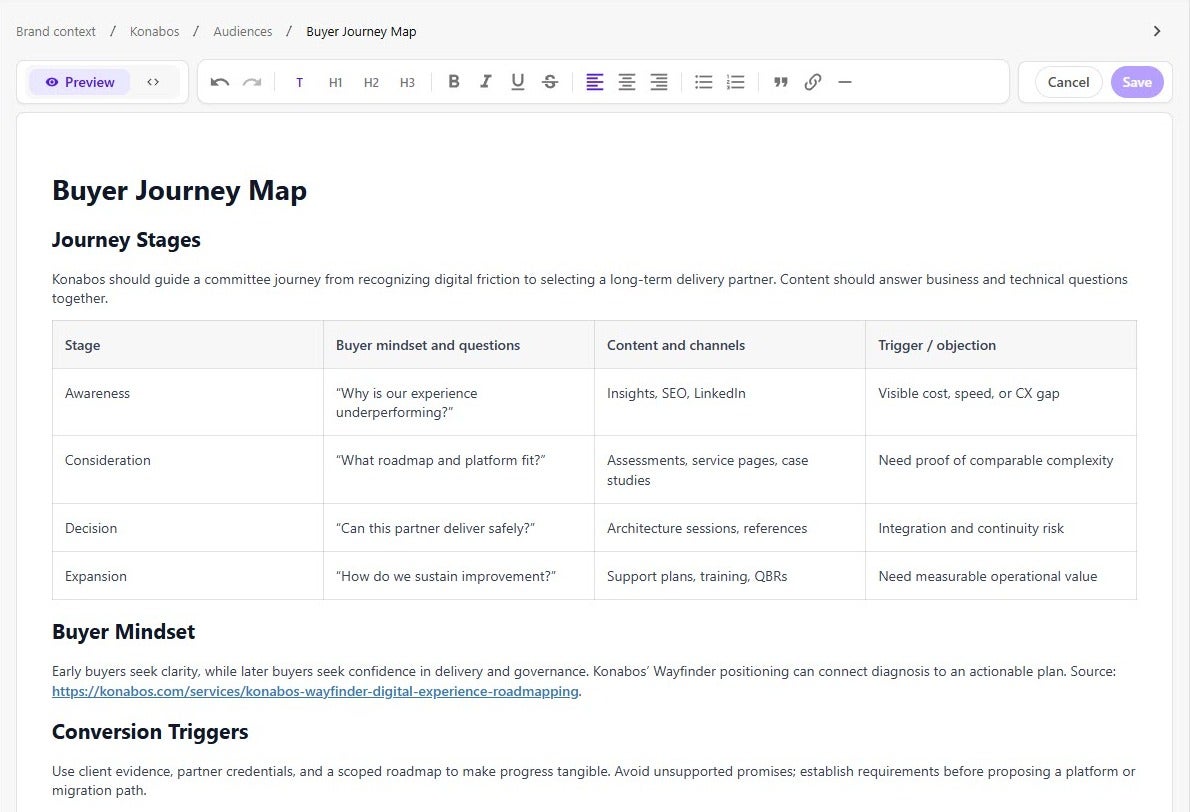
What I didn't expect was how careful it is with evidence. Competitive Positioning says our public materials support comparison on scope, platform expertise, proof and support model, but "do not substantiate broad superiority claims." Its competitor profiles are categories, not names and it labels the comparison as inferred. Success Metrics pulls the numbers from our published case studies, then notes that no cross-client or market benchmark is verified. That's the discipline I want from any AI writing on our behalf.
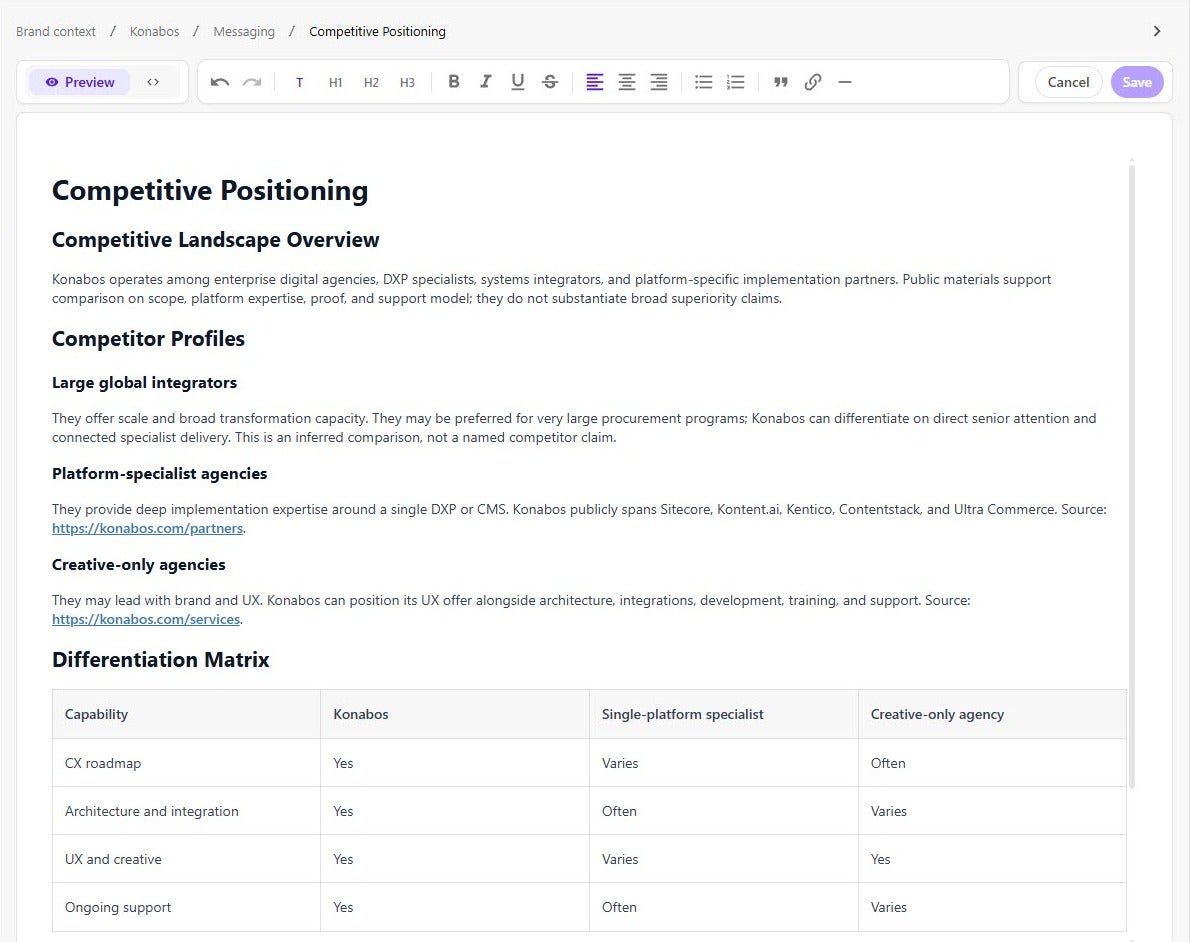
Two reads of one website
Side by side, the two tools point to the same fix. The specifics are on konabos.com. They live on our partner page, our case studies and our service pages. They just aren't in the headline positioning and that's the part an outside reader, human or AI, sums us up from.
So the job isn't to invent a new story. It's to move what Brand Context found deep in the site up to the first sentence people and answer engines read.
What I'm changing next
The setup did exactly what it should: it showed me what an outside reader can infer about us, fast and let me fix it. Here's what I'm doing with that:
- Rewrite the brand description using Brand Context's messaging and proof points as the starting point, so the first sentence says Sitecore, Content Hub and the MVP team.
- Replace the personas with the people who actually buy from us: marketing and digital leaders, content operations and the technical owners of a Sitecore platform.
- Swap the competitors for the firms we really meet in deals.
- Replace the topics with what we actually do: SitecoreAI migration, Content Hub, headless builds, AEO.
- Write real prompts by hand. Long, specific, with the constraints a buyer actually has.
- Fix konabos.com. Move what lives on our partner, case study and service pages into the home page and service headlines, then keep Brand Context current. SitecoreAI suggests reviewing flagged items monthly.
Scrunch has also started crawling the site and the prompts are live. I'll write a part two once there's real data on how often we get recommended and for what.
If you set up an AEO tool on your own site, what did the first draft get wrong about you?

Akshay Sura
Akshay is a ten-time Sitecore MVP and a two-time Kontent.ai. In addition to his work as a solution architect, Akshay is also one of the founders of SUGCON North America 2015, SUGCON India 2018 & 2019, Unofficial Sitecore Training, and Sitecore Slack.
Akshay founded and continues to run the Sitecore Hackathon. As one of the founding partners of Konabos Consulting, Akshay will continue to work with clients, leading projects and mentoring their existing teams.
Share on social media