

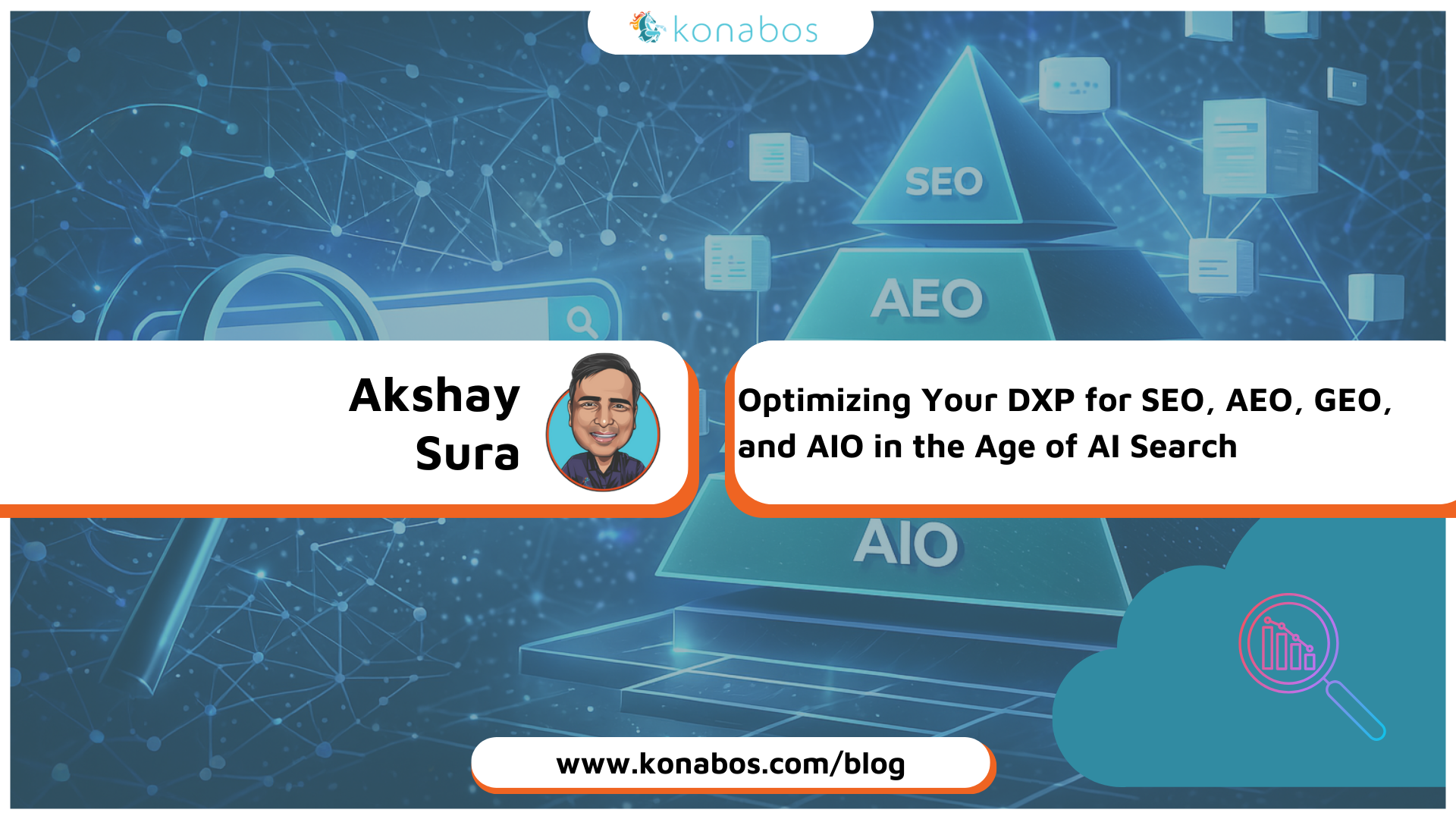
Optimizing Your DXP for SEO, AEO, GEO, and AIO in the Age of AI Search
Akshay Sura - Partner
2 Dec 2025
Search Engine Optimization (SEO) helps improve an organization's visibility, and this field continues to evolve. It's also improving through new non-traditional resources like Google AI Overviews, ChatGPT, and informative voice assistants. All of these resources and technologies contribute to SEO visibility through SERP (Search Engine Results Pages).
While many digital experience platforms (DXPs) excel in content organization, there's potential for improvement in creating answer-ready content blocks (AEO), evidence-rich topic hubs (GEO), and AI-aware workflows (AIO).
Content authors greatly benefit from structured templates with Question/Answer fields, evidence tables, and entity taxonomies, rather than free-form text.
Developers should generate a Schema based on content fields, provide clean APIs for accurate AI citation, and create reusable components for consistent markup.
In enterprise DXPs like Sitecore, optimizing content templates, rendering pipelines, schema automation, and publishing workflows can unlock the full potential of these innovations.
Why SEO Alone Is No Longer Enough for DXPs
The search landscape has evolved. Digital visibility means more than obtaining a high rank on one results page; it means visibility on all three tiers of a cross-platform visibility pyramid for discovery:
- Classic Search Engine Results Pages: This includes traditional rankings, featured snippets, and rich results found on search engines like Google and Bing.
- Generative Engines: Google AI Overviews (formerly SGE), Perplexity, ChatGPT with browsing, and Bing Copilot platforms that synthesize multi-source answers.
- Answer Engines: Voice assistants (Alexa, Siri, Google Assistant), direct-answer boxes, and in Search Engine Results Page FAQ panels that provide zero-click responses.
Digital Experience Platforms can intelligently organize content into reusable components, systematize metadata and URL management, incorporate analytics, and deliver custom-tailored content. However, a significant number of Digital Experience Platforms still do not have a content model for the following:
- Prepared content encapsulations providing the potential to be extracted and cited by AI with no modifications (AEO)
- Consolidated evidence and entities to create topic authorities for generative content summaries (GEO)
- AI-centric formatting and processes that create content catered to the needs of both the user and the machine (AIO)
This guide provides a detailed structure for executing SEO, AEO, GEO, and AIO within enterprise DXP, with specific guidance for content authors and developers.
Understanding the Four Optimization Layers in a DXP Context
Before diving into implementation, it's essential to understand that in an enterprise DXP, these four optimization types are not separate "modes" but layers on top of your existing content model, rendering pipeline, and workflow. Each build upon the previous.
Layer Definition DXP Implementation Focus
SEO Technical health, content relevance, authority, and UX that help pages rank in traditional search results, Crawlability, Core Web Vitals, semantic HTML, XML sitemaps, canonical URLs, and meta tags.
AEO Structuring content so answer engines can extract concise, verifiable answers and cite you in snippets, voice responses, and AI overviews. FAQ templates, Question/Answer fields, FAQPage schema, 40–60-word answer blocks.
GEO Increasing the chance your brand is included in multi-source AI summaries through comprehensive, well-structured, evidence-rich content: topic clusters, evidence tables, entity taxonomies, primary source citations, interlinked hubs.
AIO Using AI throughout content operations (research, briefs, drafting, QA, metadata) to publish faster and more consistently. Brief templates, AI-assisted drafting, validation workflows, schema automation scripts.
The Content Author's Perspective: Modeling and Authoring Patterns
Authors working in a CMS need explicit patterns and templates that make AEO and GEO possible without requiring every marketer to become a schema or LLM expert. The goal is to embed best practices into the content model itself.
Question-Answer Content Blocks
Of all the text generated for AEO, the FAQ content has the greatest impact. However, the lack of control over free-form rich text makes it impossible to form a trusted schema or enforce any completion quality. Instead, provide more structured data templates that include the following:
- Question field: Single line text, capped to 100 characters, framed like a natural language user question
- Answer field: Rich text, guided to a 40–60-word limit, which should begin with the answer
- Supporting context field (optional): Additional information that is displayed below the answer text
Instructions for authors: Place the answer in the first sentence. The answer to the question must come first, followed directly by short, contextual, relevant information. Do not develop a conclusion, as retracing the information in the document would have obvious disadvantages. AI systems collect the first information they encounter.
Evidence Tables and Citations
Generative engines favor content with verifiable data. Create reusable "Evidence Row" or "Stat Block" templates with structured fields:
| Field Type | Example | Purpose |
| Metric | Click-through rate | What's being measured? |
| Value | 8% with AI Overviews | The specific data point |
| Source | DXP Research, July 2025 | Attribution for credibility |
| Source URL | https://somedxpresearch.org/ | Link to primary source |
Instructions for authors: Statistics must be sourced to primary, reputable references (government sites, peer-reviewed research, prominent industry analysts). Both GEO and AEO engines weigh content higher when claims are verifiable.
Taxonomic Systems for Entity Distinctness
It is requisite for AI models to grasp the meaning behind the entire document and the general concept rather than working off of individual words in isolation. The subsequent elements necessitate the application of controlled ontologies and taxonomy classes:
- Items and offerings (ex: Kentico Xperience, SitecoreAI)
- Sectors and industries (ex: Financial Services, Manufacturing, Healthcare)
- Sectors and locations (ex: APAC, North America, EMEA)
- Case Applications and Solutions (ex: Personalization, Content Migration, Headless Architecture)
Instructions for authors: Define entities explicitly in copy, don't just imply them. Instead of "our platform," write "SitecoreAI." Instead of "this approach," write "headless CMS architecture." This clarity helps AI engines map your content to the correct knowledge graph entities.
AI-Aware Formatting Templates
There must be an insistence on AI-friendly formatting patterns being not just suggested but in fact built into content templates. Insist on the following in the templates:
- To discourage paragraphs exceeding 100 words, set up fields with rich text capabilities.
- Set up H2 fields to always address user questions, e.g., "What is…," "How does…," "Why should…".
- In fields reserved for steps, pros/cons, and definitions, do not use inline bullet formatting.
- For long-form content, a summary field should be required at the beginning of the template for TL; DR/Summary boxes.
AIO Work and Technology Integration
All AI-enabled content workflows should be integrated within the CMS rather than viewed as one-off integrations. Integration should include the following:
- Universal templates for briefs containing the following content: key questions the content is intended to respond to, AI snippets/queries the content is designed to optimize, primary reference sources, and target word count.
- AI-assisted drafting should be integrated within the CMS with the following self-imposed limitations: number of characters, types of HTML presented, and required fields.
- Administrative validation processes that ensure editors review and validate the following: fact verification, tone of voice, and required schema fields prior to publication.
- Automated QA review processes that identify and report: missing answers to FAQs, evidence that lacks source attribution, taxonomy fields that are not filled in.
The Developer's Perspective: Schema, Rendering, and APIs
How people search for and use AI is influenced by the architecture and structure of the content presented. When designing and architecting content and building components, careful attention is needed to create the appropriate structure to make the content accessible to search and AI tools.
Schema and Structured Data Implementation
The Schema is to be auto generated and must be an output of the content fields. Whenever the Schema is hard-coded, the content will pivot, the Schema will diverge from the content, and, over time, result in a loss of rich results and, in severe cases, penalties.
Basic JSON-LD must be implemented to represent the content of the page about accurately:
- FAQPage and QAPage: Created automatically with FAQ components on the page. Ensure that the Question and Answer fields are correctly mapped to the schema properties.
- Article/BlogPosting: Remember to fill the fields with the headline (obtained from the title field), author (linked to Person Schema from author field), datePublished, dateModified, publisher (Organization schema), and an image.
- Organization: Schema that is on every page. Fill the fields with name, url, logo, sameAs (for the social profiles), foundingDate, and contactPoint.
- Person: Provided for author bio pages that have name with jobTitle, worksFor (link to Organization), sameAs (LinkedIn, Twitter), and knowsAbout (the areas of expertise from the taxonomy).
- Service/Product: Provided for service pages that have the fields, provider, serviceType, areaServed, and description.
- BreadcrumbList: Navigation contextualization created from the hierarchy of the site.
Answer Engine Fields to Markup Mapping
Create custom mappings per each content model with the following output:
- Questions/Answers - FAQ Schema: Adhere to cardinality with respect to character limits and keep the Schema current with visible content
- Evidence tables - HTML Table + Structured Data: Display as semantic HTML tables with proper thead/tbody/th markup and appropriate structured data
- Taxonomy Fields - aboutSubject in Article Schema: Map entity taxonomies to Schema.org entity references
- Author Field - Person Schema Reference: Link article authors to the Schema of their biography pages using @id references
APIs and Headless Systems: A Redesign for AI
In headless DXP architectures, discoverability of AI is directly influenced by API Design. Make content available by documenting your JSON/GraphQL APIs, covering the following:
- Having clear and typed fields for Q&A, entity references, and evidence tables, and avoiding plain HTML blobs.
- Stability of IDs and URIs to avoid AI systems losing the ability to resolve references over time reliably. Do not change URLs without proper redirects.
- Content versioning should be available to AI systems, as well as policies with dateModified attributes, so that the systems can determine whether the content is current.
- The presentation should be kept separate from the content so that schemas can be created from the structured data, regardless of the frontend technology.
Reusable Component Patterns
Build design-system components that are fully configurable by authors while continually rendering a consistent HTML structure and Schema:
| Component | HTML Output | Auto-Generated Schema |
| FAQ Accordion | details/summary or div with aria-expanded | FAQPage schema with all Q&A pairs |
| Stats/Evidence Panel | Semantic table with caption and source links | Table schema or custom structured data |
| Comparison Table | thead/tbody/th table with scope attributes | Optional ItemList or custom comparison schema |
| How-To Steps | Ordered list with step headings | HowTo schema with step array |
| Author Bio Block | aside with figure/img and author details | Person schema linked via @id |
Performance and Technical Requirements
- Core Web Vitals: Focus on getting values for LCP < 2.5s, FID/INP < 200ms, and CLS < 0.1. They are essential for SEO and, consequently, AI visibility.
- Server-side rendering: Make sure structured data is on the page for the first render. Client-side hydration can block AI crawlers that are not JavaScript-enabled.
- Schema validation: Create automated systems that check the Schema on output, during deployment, or publishing. Ensure that errors never reach production.
- AI crawler monitoring: Keep an eye on GPTBot, anthropic-ai, PerplexityBot, and other AI crawlers present in the server logs. Adjust robots.txt policies as necessary.
The Functionality of The Four Layers in A DXP Context
A useful framework for understanding how SEO, AEO, GEO, and AIO are to be incorporated in enterprise DXPs:
- SEO (Foundation): Ensure all pages are crawlable, fast, mobile-friendly, and semantically structured. This is implemented through rendering pipelines, CDN configuration, and technical SEO automation.
- AEO (Answer Layer): Make sure every central question has a dedicated, structured, short answer with matching FAQ or Q&A markup. This is implemented through content templates and schema automation.
- GEO (Authority Layer): Ensure key topics have deep, interlinked content clusters, evidence tables, and clear entities so AI engines can synthesize them. This is implemented through information architecture and taxonomy design.
- AIO (Operations Layer): Use AI to systematize briefs, drafts, and QA so content ships faster and in the proper structure for the other three layers. This is implemented through workflow automation and CMS integrations.
DXP Implementation Summary
| Layer | Content Model | Technical Implementation |
| SEO | Meta fields, URL slug field, and canonical field | XML sitemap generation, canonical tags, Core Web Vitals optimization |
| AEO | FAQ template, Question/Answer fields, TL; DR field | FAQPage schema auto-generation, and answer field validation |
| GEO | Evidence table template, entity taxonomies, topic cluster linking | structured table markup, aboutSubject Schema, internal linking automation |
| AIO | Brief template, approval workflow states, validation rules | AI drafting integration, automated QA checks, schema validation scripts |
Building for AI-First Discovery
The transition from link-based to answer-based discovery searching is now underway. Users see AI response summaries and click through traditional sites 8% of the time. Without AI summaries, users click through 15% of the time. For enterprises that operate DXPs, the structural advantages are clear. They have already developed sophisticated content modeling, workflow automation, and rendering systems. The next step is to expand these systems with the suggestions in this guide.
Authors will have to work with AI-friendly templates, such as Question/Answer format blocks, evidence tables, entity taxonomies, and summary sections. Developers should set up schema automations that structure their data from content field inputs, generate reusable modules that produce consistent code output, and APIs designed for use by AI systems.
SEO is still the basis. Further, AEO, GEO, and AIO are advanced layers that will show the return on your investments in content organization, structural quality, and technical proficiency to the newer generations of discovery engines.
Contact Us
Kindly inform us of how we may be of assistance and be as detailed as you can. A member of our team will contact you directly within 1 business day.

Akshay Sura
Akshay is a ten-time Sitecore MVP and a two-time Kontent.ai. In addition to his work as a solution architect, Akshay is also one of the founders of SUGCON North America 2015, SUGCON India 2018 & 2019, Unofficial Sitecore Training, and Sitecore Slack.
Akshay founded and continues to run the Sitecore Hackathon. As one of the founding partners of Konabos Consulting, Akshay will continue to work with clients, leading projects and mentoring their existing teams.
Share on social media